AI SDR Agents vs Human SDRs for Outbound Pipeline
AI and humans excel at different stages of outbound prospecting, not the same one.
Can AI replace the SDR, or should it? That question has eaten up most of the sales development conversation in 2026, and it's the wrong one. It mistakes throughput for judgment, treating two entirely different capabilities as if they're interchangeable. A rep spending three hours a day on prospect research, list building, and CRM data entry has fewer than two hours left for actual outbound calls, and that structural mismatch is pushing teams toward AI. But the market's verdict on full automation is already in: somewhere between 50% and 70% of AI SDR tools churn within a year, and only about 2% of companies successfully run a fully autonomous AI SDR motion that actually sticks.
The clearest case study here is a warning shot. It's a warning shot. 11x.ai raised a substantial sum from Andreessen Horowitz and Benchmark on the promise of an AI SDR that could run outbound end to end, and then lost somewhere between 70% and 80% of its customers within months. That's not proof AI SDR agents don't work. It's proof that treating them as a wholesale replacement for a human function, rather than a tool with a defined scope, tends to blow up in the field. AI SDR agents and human SDRs are not competing for the same job. The teams hitting pipeline targets in 2026 are the ones who've actually mapped where each side owns the work, and who've built the handoff between them with the same rigor they'd apply to any other revenue process. That's the framework this piece lays out.
What AI SDR agents do, and what they do not
The category splits into three types, and confusing them is where a lot of deployment mistakes start. Salesmotion.io's 2026 breakdown identifies fully autonomous agents, copilots embedded in existing platforms, and intelligence layers, each with a different claim on the workflow.
Fully autonomous agents, the 11x Alice and Artisan Ava type of product, along with tools like AiSDR, source prospects, write the outreach copy, run multi-step sequences, handle replies, and book meetings with little to no human touch in the loop. Copilots work differently. Tools in the vein of Outreach's Kaia or Regie.ai and Apollo's AI features sit inside a human's existing workflow and make it faster: quicker research, drafted messages, sequence suggestions. The human still drives. Intelligence layers are narrower still. They surface signals and pull together account context, but something or someone still has to act on what they surface.
What unites all three is the type of work they take off a rep's plate: identifying prospects against ICP criteria, generating personalized first-touch outreach, running multi-touch follow-up, watching for engagement signals, logging activity into the CRM. None of them, at a price point that makes commercial sense today, replicate live phone qualification, adaptive objection handling in real time, navigating a multi-stakeholder buying committee, or the judgment call to simply not send a message because the timing or context is wrong.
Aircall's 2026 guide draws the distinction cleanly. Email automation runs a sequence a human already designed. A power dialer increases the number of dials a rep can make but still needs a human on every connected call. An AI sales agent does something structurally different: it researches, personalizes, sequences, monitors, and hands off, a materially larger scope than either automation category before it. Any 2026 deployment decision hinges on whether a tool is agentic and completes multi-step tasks on its own, or merely automated and queues up the next step while waiting for a human to click approve.
Where AI agents outperform human SDRs in the outbound pipeline
Raw volume is where the gap is widest and least debatable. AI SDR engines can push 500 to 2,000-plus outreach actions a day against a human rep's few dozen, respond to inbound signals in under five minutes instead of hours or days, and do it around the clock without needing a lunch break or a weekend off.
That volume advantage compounds at the top of the funnel. Scanning a database for accounts matching ICP criteria, pulling firmographic and technographic signals, and triggering outreach the moment a buying signal appears are tasks that scale horizontally and don't degrade in quality as the list gets longer. Outbound sequences triggered by real buying signals significantly outperform time-based cadences on both reply rate and time to first meeting. AI executes that signal-triggered logic consistently. Humans, stretched across dozens of accounts and a dozen other priorities, rarely do it at any real scale.
Around 80% of deals need five or more touches before a prospect actually engages, yet most human SDR teams give up after three. Around 80% of deals need five or more touches before a prospect actually engages, yet most human SDR teams give up after three. AI doesn't get discouraged and doesn't get tired, so it maintains full cadence discipline across the entire list, not just the top of it.
The cost math is stark. Instantly.ai's 2026 guide finds that cost per meeting from an AI-driven stack runs a fraction of the cost from a fully loaded human SDR, and a fully loaded human SDR costs $116,500 to $210,000 a year once benefits, recruiting, ramp time, and management overhead are counted. For low-to-mid ACV pipeline, that math tilts hard toward AI.
Jason Lemkin's SaaStr experiment is honest about the ceiling. Running 20 AI agents managed by 1.2 humans, the team sent 70,000 personalized emails against 7,000 from an equivalent human team, a tenfold volume increase. Lemkin's own read on the output: better than a mid-pack AE or SDR, but not better than top performers. That's the ceiling in a sentence. AI top-of-funnel performance plateaus exactly where personalization depth and contextual judgment start to matter, and it shows up in the numbers: a 3.43% platform-average reply rate on the Instantly benchmark against a human SDR average of 5.8% (Belkins, 2024).
Where human SDRs outperform AI agents in the outbound pipeline
Deal size is the cleanest dividing line in the data. Instantly.ai's 2026 guide finds that human SDRs beat AI on deals above $25,000 ACV, the ones that require actual relationship building, coordinating across several stakeholders, and adjusting an objection response on the fly rather than pulling from a script.
Cycle length compounds that advantage. Win rates on deals above $100,000 ACV depend on relationship continuity across a sales cycle that typically runs 90 to 180 days or longer, and that kind of continuity across handoffs is something AI-managed sequences aren't built to sustain.
Relationship capital is quantifiable, and the gap is large. Selling to a known contact, a former customer or a past champion who's since changed jobs, closes at a 37% win rate versus 19% for cold outreach. That's roughly double, and it's capital a human rep builds over years of relationships that an AI agent has no way to replicate.
Live phone qualification still moves the needle in ways email volume alone doesn't. The channel difference is real: phone conversations surface qualification signals that email sequences simply cannot replicate, a reminder that email cadence and pipeline quality aren't the same thing. Channel matters too: LinkedIn DMs reply at 10.3% against cold email's 5.1%, 2026 data from Expandi shows, and that gap reflects the advantage of a channel that still feels like a person on the other end.
There's a quieter function human reps serve that rarely gets counted: risk management. A rep on a call catches a hallucinated product claim, a miscategorized objection, a tone that's landing wrong, before any of it reaches a senior buyer and damages the account. AI cannot audit itself for that in real time. This is where the emerging roles point. SDRs are shifting toward consultative, high-conversation work, and new roles are emerging that blend sales strategy with AI oversight, focused on designing how agents run and curating the signals that close the feedback loop.
The data quality problem that breaks both models if left unaddressed
None of the above matters if the underlying contact data is rotten, and B2B contact data rots fast. Decay runs 25% to 30% a year, so a 10,000-record database sheds 2,500 to 3,000 usable contacts annually without active maintenance. Email addresses alone decay 23% to 30% a year; phone numbers turn over at about 18%.
The cost isn't abstract. Poor data quality costs organizations an average of $12.9 million a year, and companies lose roughly 15% of revenue to bad contact information. Those are revenue numbers, not IT tickets. On top of that, sales reps lose about 500 hours a year, roughly 62 working days, just validating and fixing contact records, which eats up around a quarter of total selling capacity before an AI motion even enters the picture.
And AI makes this worse before it makes it better. An agent firing high volumes of outreach into a stale list burns domain reputation far faster than a human sending a handful of messages manually ever could. Data quality becomes a multiplier in the wrong direction the moment volume scales up, turning a hygiene issue into a compounding risk.
A well-maintained ICP list should be 90% or higher on email validity. Below 80%, sending domain reputation starts to erode. Multi-source waterfall enrichment is the dominant fix, hitting 85% to 95% find rates against 50% to 60% for single-source platforms, with bounce rates under 1% compared to 5% to 7% on non-validated lists. The cadence that keeps this in check requires consistent re-enrichment passes across active pipeline and the broader CRM; without ongoing maintenance, decay compounds silently until the list is stale before anyone notices. Apollo's own database, holding a large contact base and a company count many times smaller than that with waterfall enrichment built directly into the platform, is one example of a data layer built to feed AI agents clean records rather than bolting hygiene on as a separate step.
Designing the handoff: the decision that determines whether the hybrid model produces pipeline or drag
Aircall frames the human-AI handoff as the single most consequential design decision in the entire deployment. Get it wrong, and the motion produces higher dial counts and nothing else. Get it right, and it produces qualified pipeline.
A bad handoff looks like this: AI books the meeting, and the human rep opens a calendar invite with no context attached. The rep walks in cold, the prospect feels the discontinuity immediately, and meeting show rates drop. A good handoff means the rep sees every touchpoint, every reply, every signal, and every enrichment data point already sitting in the CRM before the call even starts.
Much of this gets decided earlier than people think, back at the ICP configuration stage. Broad targeting criteria produce volume. Precise criteria produce meetings worth taking. So the handoff quality problem often starts long before any actual transfer happens.
Sequencing plays into this too. The optimal structure front-loads email and LinkedIn across the first two weeks and brings phone in from the fourth touchpoint onward, which means the handoff to a human should happen when phone engagement starts, not later at the point a meeting gets booked. Top-quartile campaigns clear reply rates of 15% to 25%, and the teams hitting those numbers almost always run three or more channels and score prospects before sequencing even begins, which means that scoring has to be baked into the handoff record itself, not bolted on afterward.
Building in a human review checkpoint before any prospect gets escalated to a live conversation catches errors in qualification, tone, or factual claims before they reach a buyer who matters. None of this works, though, if the CRM can't surface AI-gathered context to the rep in real time. Deep CRM integration isn't a nice-to-have in a hybrid model, it's the connective tissue the whole thing depends on. Apollo's approach, unifying sequences, AI research output, and contact data in one platform, is built around exactly that principle: the rep sees context in the same system the AI ran outbound in, closing the tool-switching gap that quietly wrecks most handoffs.
Compliance and deliverability as non-negotiable constraints on AI outbound volume
The financial exposure here is not theoretical. CAN-SPAM violations can run up to $53,088 per email as of January 2025. GDPR fines top out at €20 million or 4% of global revenue, whichever is larger. CASL penalties reach $10 million per violation. A 2025 Washington State Supreme Court ruling opened a new front entirely, allowing $500-per-email penalties for misleading subject lines, and more than 100 lawsuits have already been filed under that precedent.
Regulation is catching up to the technology, not the other way around. The EU AI Act's transparency requirements for AI-generated content take effect on August 2, 2026, with a grace period running to December 2, 2026 for systems already on the market. Any company sending AI-generated outreach to EU recipients needs a compliance plan in place now, well before that window closes.
Deliverability sits right alongside compliance as a hard constraint. Without SPF, DKIM, DMARC, and a disciplined warmup schedule, neither AI nor human outbound reaches the primary inbox with any consistency, and AI volume run against weak deliverability infrastructure burns through domain reputation faster than anything else in the stack. B2B decision-makers now receive an average of 15 cold emails a week, which makes deliverability a competitive edge rather than a background technical task.
Human review earns its place here too, independent of any relationship or judgment argument. A rep catching a hallucinated claim or a tone mismatch before it reaches a buyer is a compliance function as much as a sales one. Platforms like Apollo that build compliance and deliverability directly into the product let teams scale volume without carrying legal and inbox risk as a separate operational burden.
The hybrid model in practice: what the teams hitting targets in 2026 are doing
The number that anchors this entire argument: companies using AI to augment human SDRs, not replace them, report generating close to three times as much pipeline. That's not a projection. It's what's happening now, and it's what turns the hybrid case from a theory into an operating plan.
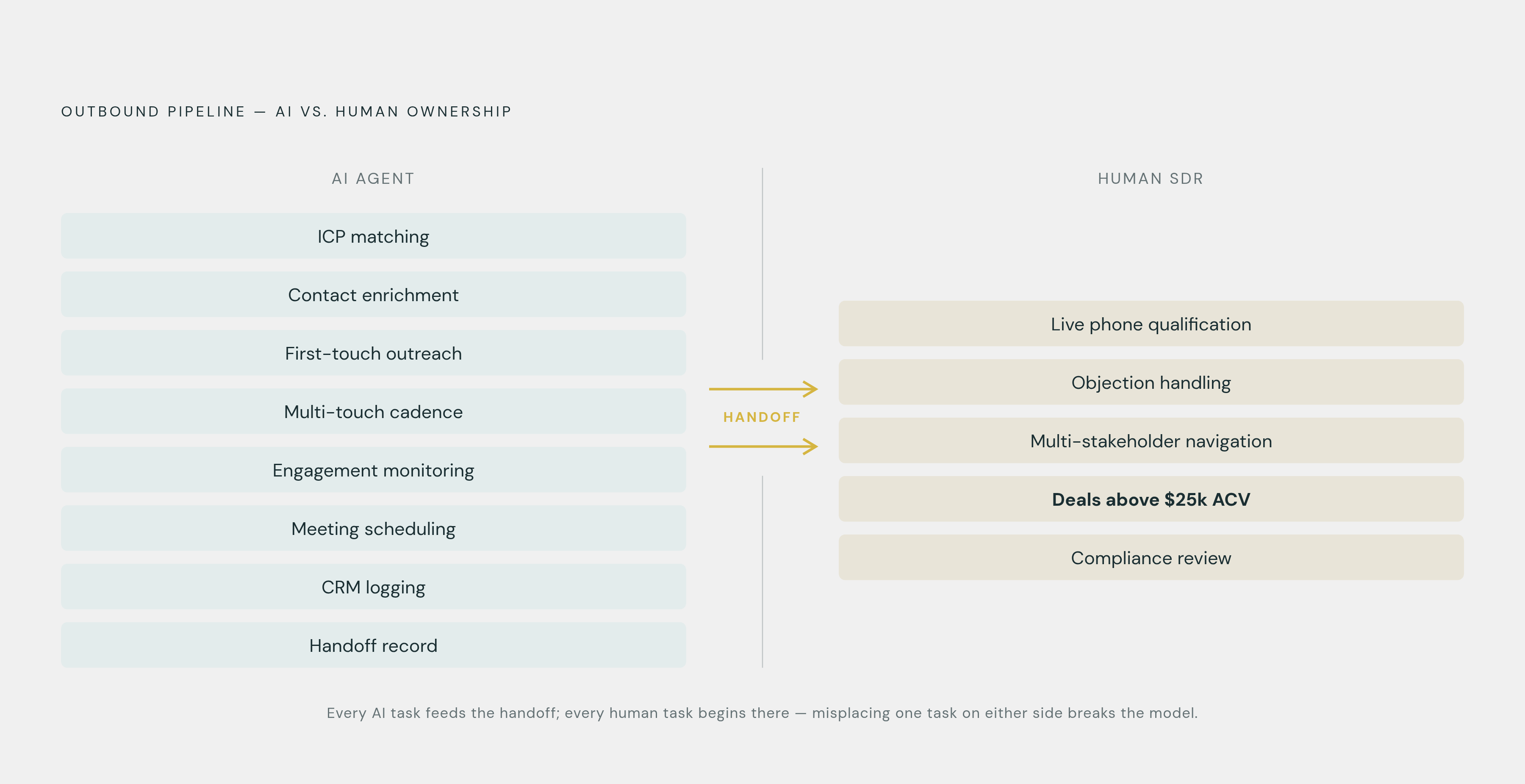
The split that data supports looks like this. AI owns ICP matching, contact enrichment, first-touch outreach, multi-touch follow-up cadence, engagement signal monitoring, meeting scheduling, CRM logging, and assembling the handoff record. Humans own live phone qualification, adaptive objection handling, navigating multi-stakeholder deals, progressing anything above $25,000 ACV, and compliance review at the point of handoff.
This isn't a niche experiment anymore. UserGems data, cited by salesmotion.io in 2026, shows 45% of sales teams are already running some version of this hybrid model, and Gartner projects 75% of B2B sales organizations will have deployed AI-augmented sales tools by the end of 2026. The direction of travel is set.
Ramp time is the detail most teams underestimate. Real-world deployments show that AI SDR systems typically take 60 to 90 days to hit steady-state output, depending on integration complexity, prompt tuning, and how clean the underlying list is. Teams with CRM integration work or list cleanup ahead of them should plan for the long end of that window, not the short one.
Roles are shifting to match. SDRs are moving toward consultative, higher-value conversation work rather than volume dialing, and new positions are appearing to keep the agent layer running well: the AI GTM architect, who designs the agent workflows, and the revenue intelligence lead, who curates the signal and feedback loop. The framework that falls out of all this is this: AI carries the volume and the repetition at a cost structure that actually justifies scaling the top of the funnel, and human reps spend their limited hours where judgment, not throughput, decides whether a deal closes.