B2B Data Provider Comparison for Outbound Teams
Four dimensions matter more than database size when choosing B2B data for outbound.

Choosing a B2B data provider is not a feature-list exercise. It's a bet on which combination of data accuracy, geographic coverage, compliance posture, and execution capability will actually turn into booked meetings for a specific outbound motion, and most teams get the bet wrong because they compare the wrong things.
The market makes this easy to get wrong. "Sales intelligence platform" gets slapped on contact databases, intent platforms, engagement suites, workflow builders, and Chrome extensions that share almost nothing under the hood. Comparing raw database sizes across these tools produces conclusions that don't hold up: ZoomInfo's own sourced figures range widely depending on when the number was pulled, spanning from the low hundreds of millions to well beyond that, and research on Seamless.AI's advertised contact figure, which runs into the billions, shows it includes significant duplication. Which mix of accuracy, segment coverage, compliance, and execution actually produces dials that connect and emails that land matters more than which database is biggest. It's which mix of accuracy, segment coverage, compliance, and execution actually produces dials that connect and emails that land. This piece uses four dimensions, not a feature matrix, because those four are what determine pipeline outcomes in the real world.
How B2B contact data degrades and why that changes the evaluation
B2B contact data rots fast. Industry research cited by DeepSync and Twilio puts annual decay at 25 to 30 percent, which means a CRM that's clean in January can be wrong or missing on roughly a quarter of its records by December. People change jobs, phone numbers get reassigned, companies merge or die. None of this is exotic. It's just the base rate of a labor market that moves.
Forbes estimates that 91% of CRM data is incomplete, and the downstream damage is not abstract. Leads get routed to the wrong rep. Forecasts skew because duplicate records inflate pipeline. Outreach hits dead emails and disconnected lines. Increasingly, AI scoring models get trained on the same dirty inputs, so the errors compound instead of averaging out.
Vendor match rates published at 90 to 95% rarely survive contact with a real CRM. A Cleanlist benchmark run against 1,000 real leads found Apollo at 78% email accuracy and ZoomInfo at 84%, both meaningfully below what's printed on the sales page. That gap matters less as a knock on either vendor and more as a lesson about how to read any claim in this category: treat published accuracy numbers as a hypothesis, not a fact, until they've been tested against records in the segments a team actually sells into.
This is part of why waterfall enrichment has become a working response to the problem. No single vendor has full coverage, and because the gaps in one database tend to be uncorrelated with the gaps in another, layering multiple sources and taking whichever one returns a verified hit raises both coverage and accuracy at once. Understanding the mechanism before getting into specific providers reframes the whole evaluation: the goal isn't finding the one database with no holes. That database doesn't exist. The goal is figuring out which combination of sources, verification steps, and refresh cadence gets closest to zero holes for a given list.
The four evaluation dimensions that predict outbound outcomes
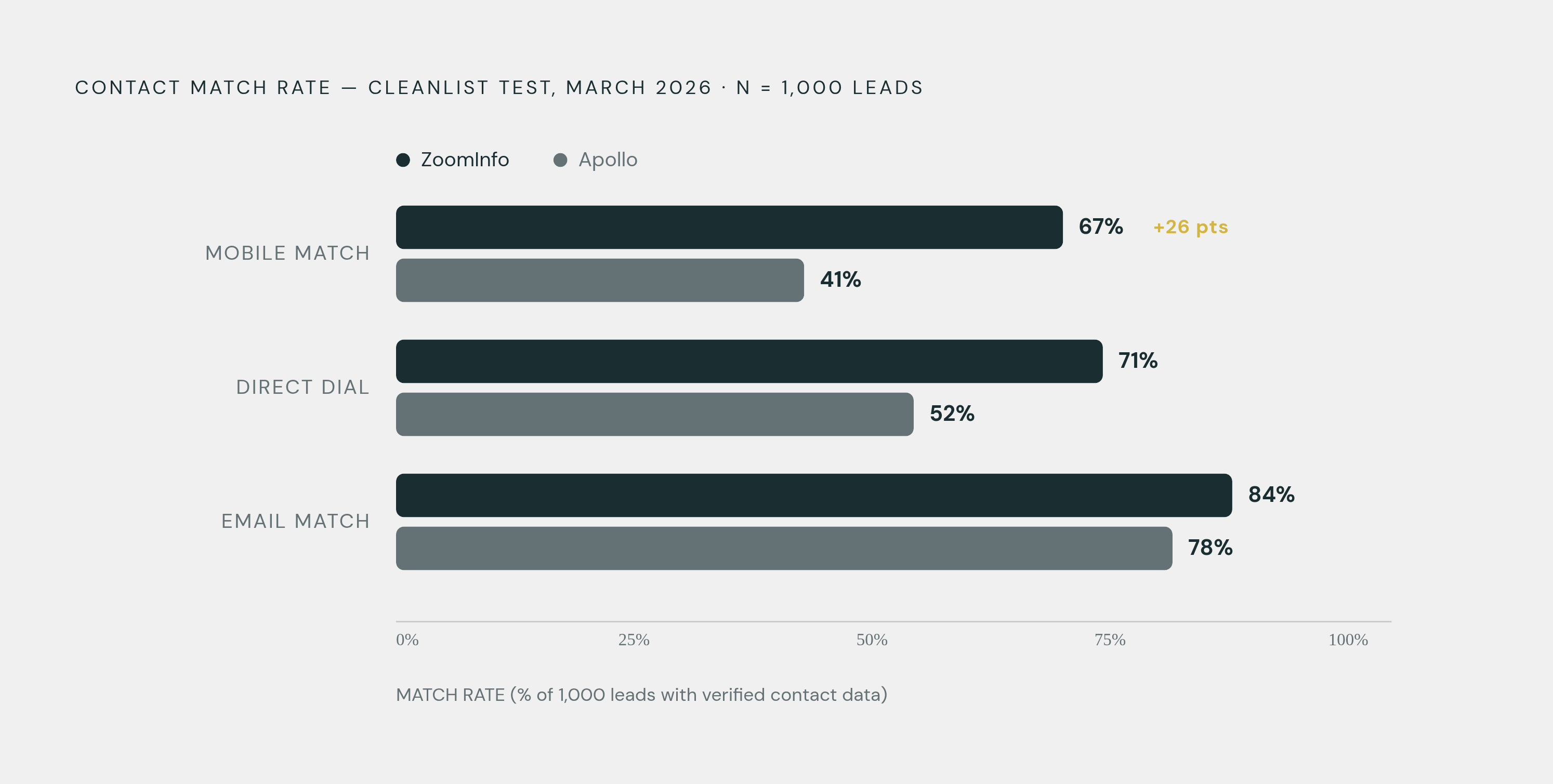
Accuracy in the segments that matter. A headline match rate is an average, and averages hide the vertical and geography splits that actually affect a campaign. The Cleanlist benchmark tested 1,000 leads split across SaaS, manufacturing, healthcare, financial services, and professional services, weighted 70% US, 20% EU, and 10% APAC, and found real divergence even between the two biggest providers in the set. The starkest gap was on mobile numbers: ZoomInfo returned a 67% mobile match rate against Apollo's 41%, a 26-point spread that translates directly into how many reachable dials a calling team gets through in a day. Job title accuracy, by contrast, was close enough to call a tie: Apollo at 89%, ZoomInfo at 92%. That's not the differentiator vendors position it as. The practical move here is simple: pull a sample of known-good records from an existing CRM and run it through a provider's API before signing anything.
Coverage where the team actually sells. US direct-dial data and European mobile data are not the same problem, and providers built primarily around US contact graphs tend to show it once a list expands into EMEA. Coverage on companies under 50 employees also degrades faster and is less reliably maintained across the board, regardless of provider, simply because smaller companies churn contacts and org charts more often than large enterprises do.
Compliance posture. GDPR governs how personal data on EU individuals gets collected, stored, and used, and a provider that sources contact data in ways that don't hold up under that framework creates legal exposure that outlasts any short-term lift in reply rate. How is the data sourced, what happens on a deletion request, what does sub-processor documentation look like, and is there screening against do-not-call lists. For teams selling into a region with strict data-protection rules, or into regulated industries anywhere, this is a line item procurement will ask about before the contract gets signed. It's a line item procurement will ask about before the contract gets signed.
Execution capability. A data provider that hands off to a separate sequencer, a separate dialer, and a separate CRM creates friction at every seam, and each handoff is another place for a good record to go stale or get mistyped. The real question: does the platform close the loop from finding a contact to actually reaching them, or does a rep have to export a CSV and reimport it somewhere else? AI-driven execution layers, agents that research accounts, build lists, draft outreach, and schedule meetings, are starting to separate the platforms that treat data as a byproduct of a workflow from those that still treat it as the whole product.
Provider profiles: what each tool does well and where it falls short
Apollo. The database runs a substantial share of the market in people and a smaller but still sizable count of companies, validated through what Apollo calls its Living Data Network, with a reported email accuracy rate of 98%. What sets Apollo apart structurally is that data, sequencing, a dialer, AI research, and enrichment all live in one workspace, so a rep builds a list and launches outreach without switching tools. Apollo MCP connects that data and those workflows to AI assistants including ChatGPT, Claude, and Perplexity, and Apollo CLI gives technically-minded teams terminal-native access for headless go-to-market builds. Pricing is public and simple to check: a free plan with 900 credits a year, and paid tiers from $49 to $119 per user per month on an annual plan. Ramp's vendor spend data as of August 2026 shows Apollo held a 39% adoption rate among buyers in the Sales Data Provider category, ranking second overall and pulling the highest share of first-time buyers among tracked vendors, which suggests it's winning a disproportionate number of teams making their first purchase in the category.
The Cleanlist March 2026 benchmark put Apollo at 78% email match, 41% mobile match, and 52% direct dial match on the 1,000-lead test set. That mobile and direct-dial gap against ZoomInfo is real and worth planning around, especially for a team that dials heavily. Apollo's own documentation shows EMEA coverage runs thinner than US coverage, and intent data is sourced through LeadSift rather than built natively. Apollo fits well for startups through mid-market teams that want data and execution under one roof without enterprise pricing or a multi-year contract, and it's a strong pick for GTM engineers building automated workflows off the API or MCP layer.
ZoomInfo. The database figures conflict depending on the source: one source cites a large set of contacts, company profiles, verified emails, and direct dials, while another cites an even larger count of professional profiles alongside a substantial number of company records. Both numbers should be held loosely. What's clearer is the phone data advantage: 67% mobile match against Apollo's 41%, and 71% direct dial against Apollo's 52%, in the same Cleanlist benchmark. ZoomInfo's GTM Context Graph fuses its proprietary data with CRM records, conversation intelligence, and buyer intent signals, aiming to explain not just what happened in a deal but why. The product line spans ZoomInfo Professional, Copilot Advanced, Copilot Enterprise, Marketing Demand, ABM Lite, and ABM Enterprise, with conversation and engagement tools sold as separate modules rather than bundled into the base plan.
Pricing isn't published. Vendr records a median annual contract of $33,500 across 1,571 tracked purchases, with the Professional tier costing roughly $14,995 a year, Advanced around $24,995, and Elite near $39,995; enterprise deals with intent data and org-chart features often run between $25,000 and $60,000 annually, and contracts are annual only, with no monthly option. ZoomInfo has been named a Forrester Wave Leader for Intent Data Providers B2B in Q1 2025 and a Gartner Magic Quadrant Leader for ABM Platforms in both 2024 and 2025. The gaps include European coverage that's thinner than the US side, a price and deployment complexity that puts it out of reach for lean teams, a steeper onboarding curve than most point solutions, and an 84% email accuracy rate in the benchmark that, while better than Apollo's, still trails the number on the label. ZoomInfo fits large organizations with real budget that need deep US phone coverage, intent data, and ABM orchestration, and it's a poor match for an early-stage company without a dedicated RevOps function to run it.
Lightweight and volume-oriented alternatives. Seamless.AI markets itself on real-time, AI-driven contact search and sheer volume, which appeals to high-velocity outbound teams, but its advertised contact figure, which runs into the billions, includes significant duplication according to the research behind it, and reviews on data accuracy and the renewal experience run more mixed than what's reported for Apollo or ZoomInfo. RocketReach offers a straightforward, large indexed pool on a simple per-lookup pricing model, and tends to attract recruiters and individual prospectors who need occasional lookups rather than a full outbound database. None of these are wrong choices for the right use case. They're just built for a narrower job than a full-funnel outbound motion.
Named alternatives worth tracking. Lead411, appearing on the confirmed 2026 short list of ZoomInfo alternatives, is known for intent-triggered lead data and pricing that flexes more than ZoomInfo's does, though available profile depth on it is limited. Kaspr, also on that short list, is a LinkedIn-focused enrichment tool with a following in European markets. UpLead, the third name on the list, is positioned around email verification and real-time data validation at price points below ZoomInfo's. The sourcing on all three establishes them as legitimate names to evaluate rather than as fully profiled options, and that limitation should be stated rather than papered over with claims the available material doesn't support.
Provider divergence: phone coverage, European reach, and contract structure
Phone coverage is the sharpest line in the data. The Cleanlist March 2026 benchmark, run on 1,000 real leads, is the clearest evidence available: ZoomInfo's 67% mobile match against Apollo's 41%, and ZoomInfo's 71% direct dial against Apollo's 52%. For a team whose outbound motion runs primarily through cold calling, that 26-point mobile gap is not a rounding error. It's the difference between a rep working a list where two-thirds of numbers connect and one where fewer than half do, and on a team making outbound calls at scale, that gap compounds across every rep, every day, every quarter.
European reach is the second major divergence, and it runs in the opposite direction from a simple "one vendor wins everything" story. Providers built around a contact graph centered on one large domestic market tend to show real thinness once a list moves into another region, both on mobile numbers and on the freshness of company data. Any team selling primarily into a market outside that provider's home base should treat those benchmark numbers as close to irrelevant and demand a same-methodology test run against a lead sample from the region they actually target before committing budget.
Contract structure is the third fault line, and it's as much a buying-process question as a data question. Apollo publishes pricing outright, with monthly and annual options and a functional free tier, which suits a team that wants to test before it commits. ZoomInfo sells exclusively on annual contracts with pricing negotiated deal by deal, landing at a median around $33,500 a year per Vendr's tracked purchase data, which suits a team with budget certainty and a procurement process built for that kind of commitment. Neither structure is objectively better. They serve different buying situations, and the mismatch between contract structure and organizational buying process causes as many failed vendor relationships as any gap in the data itself.