AI Prospecting Tools Comparison for Talent and Recruiting Ops Teams
Find the right AI recruiting tool by identifying which workflow bottleneck it actually solves.

A recruiting ops leader sitting through a dozen vendor demos in 2026 hears the same word over and over: agentic, end-to-end, autonomous. Almost none of those demos answer the only question that matters, which is what specific bottleneck in the hiring workflow a given tool actually fixes. A single "best AI recruiting tool" ranking cannot answer that question, because the AI prospecting market is no longer one market. It has split into layers that solve different problems, and picking a winner across layers instead of within one produces mismatch rather than gains.
The split runs deeper than branding. Open-web sourcing engines, CRM and outreach platforms, and agentic end-to-end systems are each at a different point in the hiring workflow, and each demands its own evaluation criteria. A sourcing engine is judged on database breadth and match quality. A CRM is judged on nurture cadence and pipeline health. An agentic platform is judged on how much of the decision chain it can run without a human in the loop.
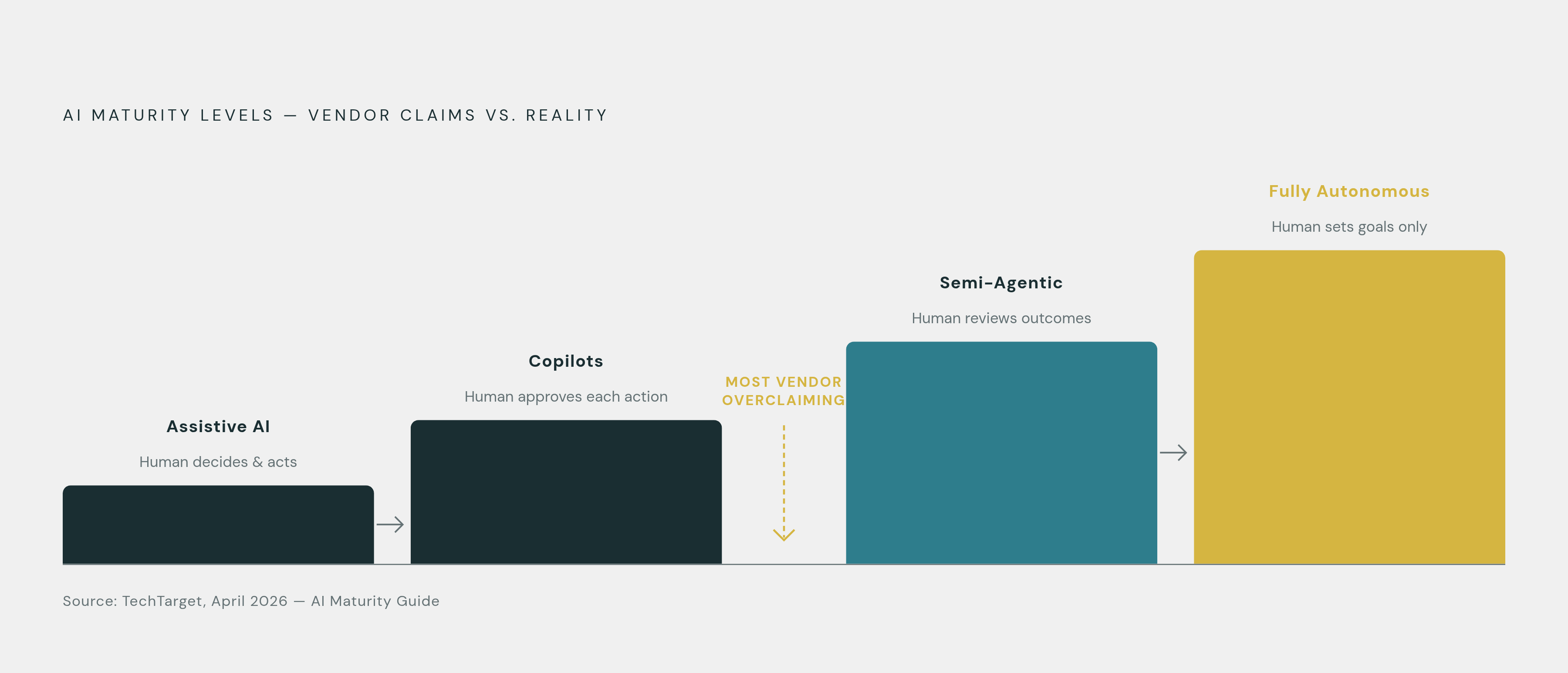
Most comparison guides ignore that distinction and rank all three layers against each other at once, which puts a team whose real problem is sourcing volume in the position of comparing CRM platforms, and puts a team drowning in cold pipeline in the position of comparing sourcing engines. Lever's 2026 guide states the problem directly: "The right AI recruiting tool for a growing mid-market team isn't the right one for a large enterprise running high-volume hourly hiring," and the guide organizes its recommendations by fit rather than by rank. TechTarget's April 2026 guide makes a parallel point from the vendor side, identifying four distinct AI maturity levels, assistive AI, copilots, semi-agentic, and fully autonomous agents, and warning CHROs to tell them apart because many vendors claim to have agents but deliver copilots.
The question a recruiting ops team needs to ask before opening another demo is not which tool ranks highest, but which layer of the workflow is the actual bottleneck right now. The rest of this piece is built to answer that question, layer by layer.
How fast adoption has moved
The pace of adoption has turned AI capability from a future advantage into a present gap, with AI-enabled and non-AI-enabled recruiting teams now separated by a measurable competitive disadvantage rather than a future risk. AI use specifically for recruiting has roughly doubled in a single year. That kind of acceleration changes the competitive math for any team still deciding whether to act.
The consequence appears in revenue, not just in workflow metrics. A gap that widens that fast closes the window for waiting to see how the market shakes out.
Most teams are not starting from a blank page. Roughly a third of firms remain primarily in the generative AI stage, while roughly another third have already moved into some level of agentic AI, which puts the typical recruiting organization somewhere in the middle of a transition already underway rather than at its starting line.
Gartner research reports that most HR leaders haven't seen significant value from their AI investments. The data behind that finding points to a measurement problem rather than a tool problem. Leaders tracking a single metric, usually time-to-fill, miss the value these tools generate elsewhere in the funnel, and a portfolio view tells a different story than a single-metric view. That reframes the real decision facing recruiting ops teams. The real decision facing recruiting ops teams is which layer of the workflow to invest in first, and that is the question the rest of this piece resolves.
Layer one: what separates open-web sourcing engines
Open-web sourcing engines aggregate public candidate profiles at scale, apply AI matching to rank results, and in some cases automate the first round of outreach. For a team whose pipeline is thin because it can't find enough qualified candidates in the first place, this is the right layer to evaluate. The differences that matter between tools in this category are database breadth, how the search interface works, and how much of the process actually runs without a human, not how many profiles a vendor claims to hold.
hireEZ is a pure sourcing engine, and Lever's 2026 guide lists it as the best fit for teams layering open-web sourcing onto an ATS they already run. Its EZ Agent covers five stages of the workflow, research and intake, source and qualify, engage and nurture, match and screen, and schedule interview, pulling from more than 45 external platforms. hireEZ describes EZ Agent as semi-autonomous: a human stays in the loop rather than being replaced by it. In November 2025, hireEZ added ResumeSense, built to flag hidden text, prompt injection, and AI-manipulated resumes.
SeekOut is at the enterprise end of this layer, with a database of 1B+ profiles pulled from LinkedIn, GitHub, Google Scholar, patents, and other public sources, searchable through more than 300 filters. It has a strong reputation for technical, healthcare, and diversity hiring. In 2026, SeekOut shipped SeekOut MCP, which lets recruiters search from inside Claude, ChatGPT, Gemini, Copilot, and other MCP-compatible assistants through 14 guided workflows, and the company also added six specialized AI agents along with Sam, a tool for rubric-based asynchronous candidate screening.
Juicebox, formerly branded PeopleGPT, takes a different approach built around natural-language search: recruiters describe an ideal candidate in plain English instead of building Boolean strings, and the tool searches across hundreds of millions of profiles pulled from more than 30 data sources. Lever's 2026 guide notes both a paid tier and a free tier are available.
Eightfold AI uses deep learning to analyze career trajectory patterns across its profile dataset, predicting both candidate fit and the likelihood a candidate will switch roles. It carries enterprise pricing and a long implementation cycle, and Lever's guide positions it for large enterprises that want skills-based matching rather than keyword search.
Workable offers AI sourcing with pricing that's published rather than quoted on request, one-click posting to more than 200 job boards, built-in AI screening, and a free trial. Lever's guide positions it for teams that want sourcing capability without the opacity of custom quotes.
The detail that separates marketing from reality in this layer is autonomy. Tools like hireEZ and SeekOut automate candidate identification and can run templated outreach sequences on their own, but once a candidate actually replies, a human has to take the conversation from there. That handoff point is where most tools marketed as "autonomous sourcing" actually sit today.
This layer fits teams that already have an ATS in place and need more reach in candidate discovery. It is the wrong layer for a team whose real problem is pipeline nurture or downstream engagement, no matter how good the sourcing database looks in a demo.
Layer two: CRM and outreach platforms built for long-arc relationship recruiting
Sourcing engines answer "can we find enough candidates." CRM and outreach platforms answer a different question: can the team stay in relationship with candidates who won't be ready to hire for months. This layer manages multi-touch outbound sequences, tracks pipeline health and engagement, re-engages past applicants, and connects recruiter activity to the hires that eventually result.
Gem is the clearest example of this layer, positioned explicitly as a sourcing CRM rather than a candidate database. It's built for the long arc where first contact and eventual hire sit months apart. Gem's AI Fraud Detection Agent, live since April 2026, screens every inbound application automatically across multiple fraud signals, and a free trial is available.
Lever takes a different path to the same layer by building the CRM directly into a native ATS. Teams source, track, and nurture candidates in one platform, with nurture campaigns for talent pools and re-engagement of past applicants. Its Talent Fit matching surfaces candidates aligned to open roles, and it includes AI Interview Transcripts and Summaries. Pricing runs on a custom quote, and Lever's own guide positions the platform for mid-sized, growing in-house teams. Gem and Lever aren't competing for the same buyer here: one is a standalone CRM layered onto whatever ATS a team already runs, the other folds ATS and CRM into a single system.
Manatal rounds out this layer at the affordable end, pairing AI candidate scoring and enrichment with ATS and CRM functions in one package, with a free trial and pricing aimed at small teams.
A team that has already invested in a strong sourcing engine still runs into a wall further down the funnel, and the data explains why. AI compresses sourcing time substantially, but LinkedIn Talent Solutions data shows it produces only a modest reduction in the overall time it takes to fill a role. A faster sourcing engine without a CRM layer behind it just moves the bottleneck downstream instead of removing it.
Mercury Hampton, a UK executive search firm specializing in engineering, aerospace, and manufacturing, illustrates what that layer is worth in practice. After deploying AIRA Job Change Alerts to monitor changes across its candidate database, the firm attributed a significant share of revenue to those alerts alone. The lesson generalizes: in staffing contexts, CRM-layer signals, not raw sourcing volume, are what drive revenue.
This layer fits a team that already has a sourcing motion running but watches its pipeline go cold before candidates convert, and it fits staffing agencies managing candidate relationships across long time horizons.
Layer three: agentic and integrated systems claiming end-to-end recruiting
Every enterprise recruiting platform now markets itself as agentic, but the word covers an enormous range of actual capability, from genuine multi-step autonomous execution down to a single automated handoff wrapped in new language. This is the layer where the gap between claim and capability is widest, and where a recruiting ops team stands to lose the most by taking a vendor's word for it.
Paradox, built around its Olivia assistant, runs conversational screening and scheduling through chat and SMS, and can carry an entire hiring process for an hourly worker through a series of text exchanges. TechTarget's April 2026 guide reports that Workday acquired Paradox. Pricing runs on a custom quote, and the platform is built for high-volume frontline and hourly hiring.
HiredScore, built for Workday customers, prioritizes candidates using AI designed to be explainable, with a compliance-first approach to grading, and custom quote pricing. Eightfold AI reappears at this layer as a full talent intelligence platform rather than just a sourcing tool, matching skills across both external sourcing and internal mobility for large enterprises; Recruiterflow's guide states that AWS uses it to match internal talent against open roles.
A newer group of vendors leads with agentic positioning from the outset: SpiderX AI markets multimodal autonomous recruiting agents, Cielo ties agents directly into talent acquisition workflows, and Torre.ai claims agentic recruiting that runs from sourcing through placement. SeekOut's MCP integration points toward a different model entirely, embedding sourcing capability inside assistants like Claude, ChatGPT, Gemini, and Copilot rather than building a standalone platform, a bet that recruiting interfaces are moving into the tools recruiters already use for everything else.
Faced with any vendor claiming agentic capability, the diagnostic question that separates real capability from rebranded automation is whether the system runs multiple steps autonomously and makes its own proceed-or-reject decisions, or automates one step and hands the rest back to a human. TechTarget's guide identifies four maturity levels, noting that CHROs should be aware of the differences because many vendors claim agents but deliver copilots.
Integrated HCM suites like Workday Recruiting and Greenhouse take a third approach, treating AI as a feature bolted onto an existing system of record rather than a purpose-built agentic layer. Workday Recruiting implementations typically run six to eighteen months, averaging around eight, and the AI and advanced features are licensed separately from the base system. That timeline alone should factor into any build-versus-buy decision a recruiting ops team makes this year.
Bullhorn Amplify offers one of the cleaner ROI signals in the staffing-agency context specifically: customers report meaningfully more submissions and higher fill rates after adopting it. That kind of result is the exception in a layer otherwise crowded with unverified claims.
This layer fits large enterprises or high-volume staffing operations that have dedicated recruiting ops resources to manage implementation and ongoing oversight. It is the wrong layer for a team without a sourcing or CRM foundation already in place, because an agentic system built to accelerate a workflow that doesn't yet exist has nothing to accelerate.
The bias and compliance risk that applies across all three layers
No matter which layer a recruiting ops team is evaluating, the same risk travels with the AI underneath it: the system is only as fair as the data and the matching logic it was built on, and both sourcing engines and CRM platforms are now layering in enough automated decision-making that bias and compliance exposure can enter at the sourcing stage, the nurture stage, or the agentic handoff stage alike. A sourcing engine that ranks candidates by pattern-matching against past hires risks encoding whatever bias shaped those past hiring decisions. A CRM that automates re-engagement sequences risks applying those same patterns at scale, repeatedly, across every candidate pool it touches. An agentic system that makes proceed-or-reject decisions without a human checkpoint carries the most exposure of all, because there's no natural point in the workflow where a recruiter would catch an error before it affects a real candidate.
The tools built with explainability and integrity checks in mind, HiredScore's compliance-first grading, hireEZ's ResumeSense screening for manipulated resumes, Gem's fraud detection agent, are responding to a risk present at every layer of this market, not just the agentic one. Any recruiting ops team building a vendor shortlist against the framework laid out here should treat bias auditing and compliance design as a baseline requirement at every layer, even before the system reaches full autonomy.