Waterfall Enrichment Setup for B2B Contact Data
Stacking multiple data providers in sequence closes the coverage gap single vendors cannot fill.
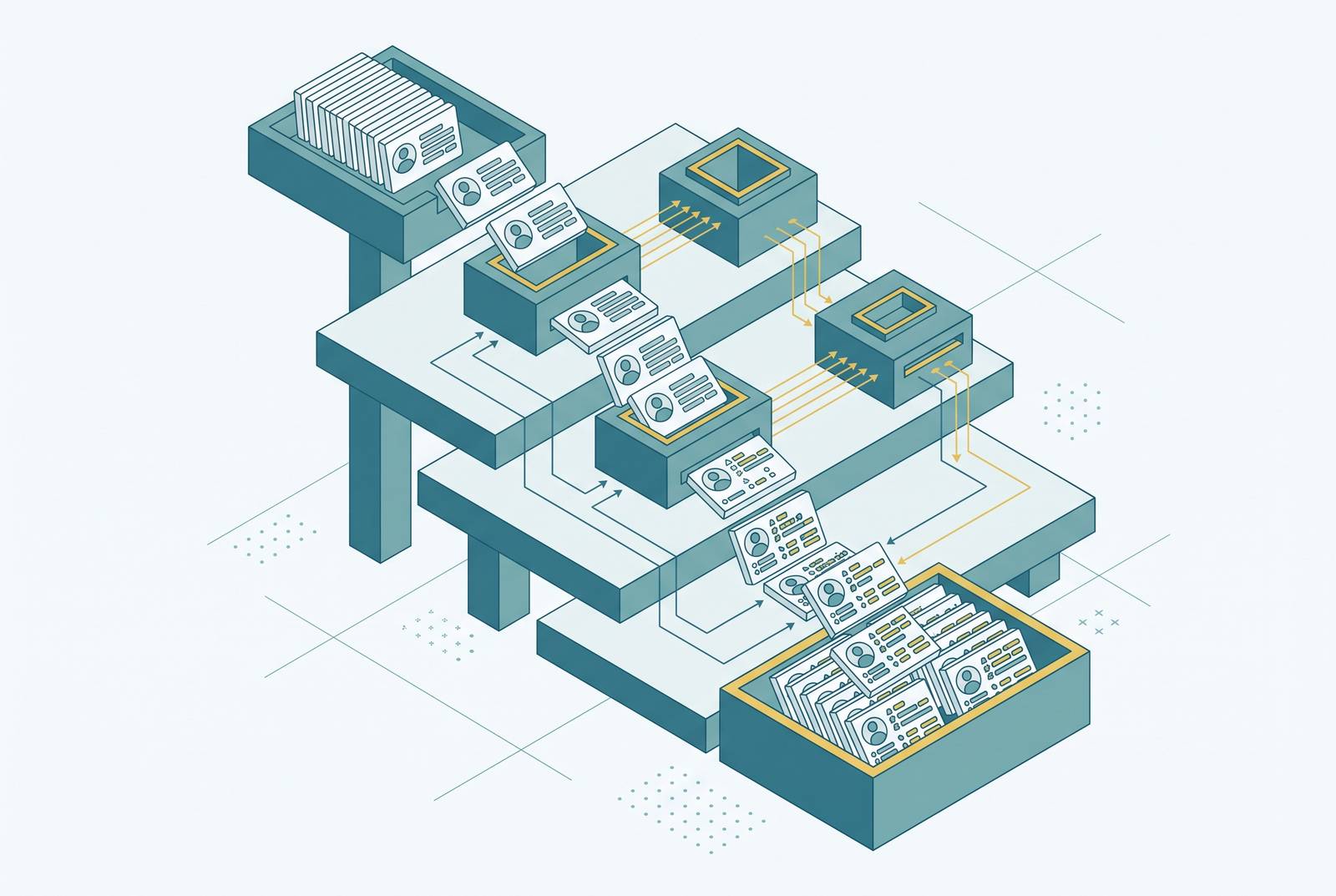
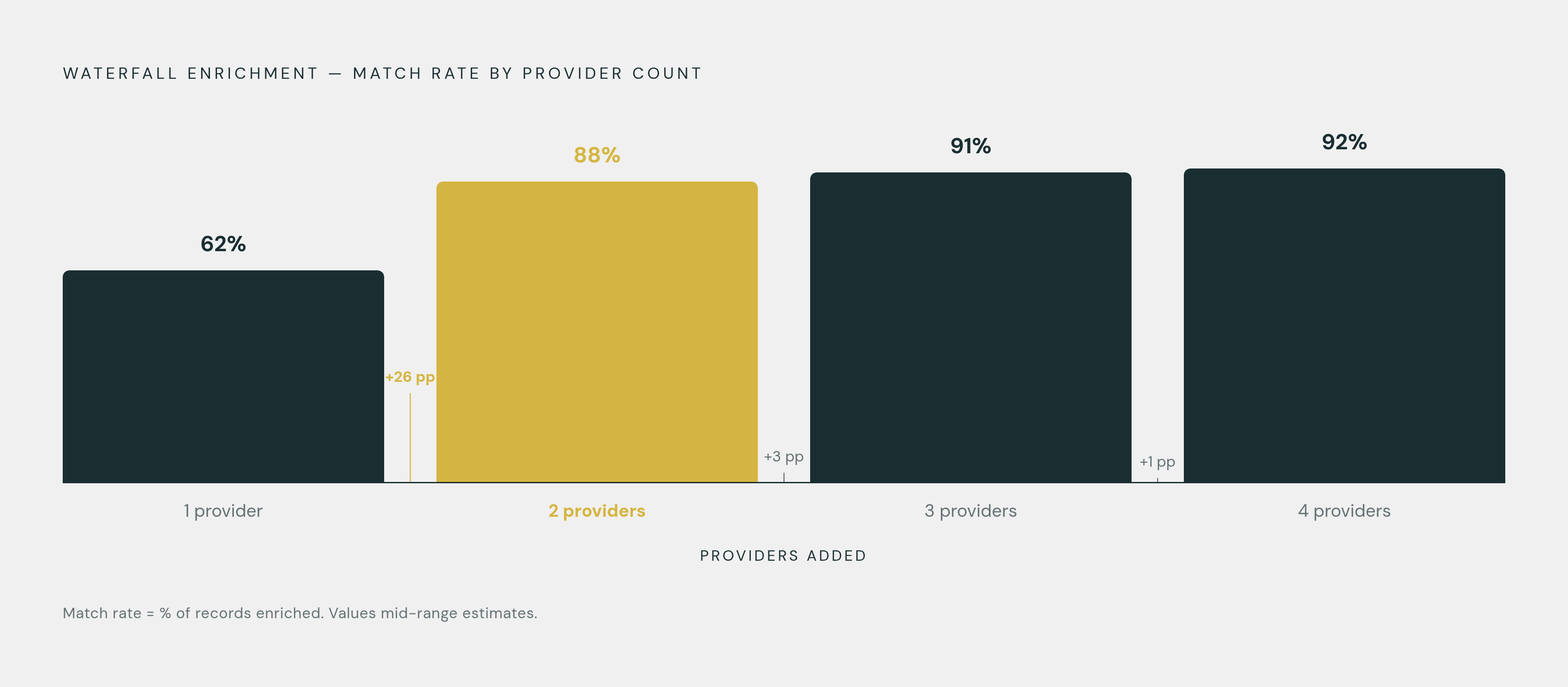
Match rates for B2B contact lists built on a single data provider typically run between 55% and 70%. A list routed through a waterfall pipeline of three to four providers climbs to an 85-95% match rate. The gap between those two numbers is a structural feature of how B2B contact data exists in the world, not a function of picking a better vendor, and understanding why requires looking at what a single provider can and cannot see.
No provider, no matter its size or reputation, has a complete picture of any given contact list. Each one builds its database from a different mix of public records, scraped sources, user-submitted data, and partner feeds, and each mix has holes the others happen to fill. A vendor can have 500 million contact records and deep US enterprise org charts, but still miss the mid-market accounts a smaller, more specialized provider covers well. It is a coverage ceiling built into how the market works, and every single-source list runs into it.
Data decay makes the problem worse, and it never stops. A contact record does not go stale once and then sit still. It degrades continuously, and the mechanism is simple: people change jobs. A single job change can invalidate several fields in a CRM at the same moment. Someone takes a new title at a new company, and their email, direct dial, title, and employer all go wrong in one stroke, not one at a time. Firmographic data, the company-level details like headcount or industry classification, decays too, just more slowly, and that slower pace makes it easier to miss until it has drifted far from current reality.
Those two problems together leave any team enriching against one provider with a clear ceiling. A list enriched once against a single source carries that provider's original gaps on day one, and it keeps losing ground after that as decay introduces new errors before the next refresh ever happens. Teams that lean on a single provider are not making a reasonable trade-off between cost and coverage. They are operating with a ceiling on how many contacts they can actually reach, and because the gaps are invisible inside a single-source list, most teams enriching this way do not know the size of what they are missing.
How a waterfall pipeline closes the coverage gap
Waterfall enrichment addresses the coverage ceiling by querying providers in a priority order and stopping as soon as a verified result comes back. The sequence works the way a cascade works: query Provider A first, and if it returns nothing or returns something low-confidence, pass the record to Provider B, then to Provider C, stopping the moment a match is confirmed. Each provider downstream only ever handles the records the one before it failed to resolve, so the pipeline spends its effort narrowing the miss pile rather than re-querying contacts that are already solved. Amplemarket's 2026 enrichment evaluation defines waterfall enrichment as querying multiple data providers in sequence until verified contact information is returned.
The stop-on-match rule is what keeps this efficient. Because providers downstream in the sequence are only called when the one before them fails, a team avoids burning credits on redundant lookups for contacts that are already resolved, and this is where waterfall enrichment goes beyond simple fallback logic and into field-level merging. A record's email might resolve from Provider A while its mobile number resolves from Provider C, so the output is a composite record built from whichever provider holds the strongest value for each field, not a single provider's full answer or nothing.
The coverage gain from adding providers does not scale in a straight line. Going from one provider to two produces the largest jump in match rate. Adding a third provider after that still helps, but by a meaningfully smaller amount, and each additional provider past that point adds progressively less. This matters for how a team should think about pipeline design: the first additional source is the highest-leverage decision in the entire setup, and diminishing returns set in quickly after that.
Waterfall is a querying logic that can run inside either real-time or batch mode, rather than a separate category of enrichment sitting alongside them, a point that matters directly for the architecture decisions covered later in this piece. What does not change regardless of mode is the role of verification. A result that comes back from any provider in the sequence is a candidate value, not a confirmed contact, until an SMTP check clears it. Cleanlist AI's 2026 analysis of waterfall tools lays out the process as a four-step run: normalize the input data, cascade the record through the provider sequence, merge the winning fields into a single golden record, and verify the winning email before that record is allowed into the final list. Skipping that last step produces a list marketed as "verified" that still carries a significant bounce rate, because bad records produced by aggressive fuzzy matching are invisible to a team that never ran the SMTP check that would have caught them.
Provider order and stop conditions: the decisions that determine whether the waterfall performs
Once the mechanism is clear, the question becomes how to configure it, and the order in which providers are queried is the single variable a team controls that most strongly affects whether the pipeline performs. Get this wrong, and the waterfall still runs, but it just burns credits without meaningfully improving coverage.
Provider order has to be set by how well each provider's coverage and accuracy fit the team's own ideal customer profile, not by a default sequence or by taking a vendor's marketing claims at face value. A provider with excellent US enterprise coverage is the wrong provider to anchor a sequence built for an EMEA-focused sales team. The provider that should sit first in one team's sequence may belong third or fourth in another team's, because it depends entirely on whose contacts each provider actually covers well. The only reliable way to set this is to benchmark the candidate providers against the team's own records and measure which one resolves the most verified matches for that specific ICP, rather than trusting a vendor's stated coverage numbers.
The anchor provider, the one queried first, should be whichever one produces the strongest combination of coverage and accuracy for the team's primary ICP segment. The providers that follow should be chosen specifically to fill whatever gaps the anchor leaves behind, not simply added for the sake of having more sources in the sequence. In practice, this often looks like anchoring on a large database provider to clear the first and largest tier of matches, adding a specialist finder tuned to a narrower data type or region to pick up the next tier of misses, and keeping a final fallback provider for whatever remains. Counting providers is a weak way to judge a waterfall's strength, because many email finders resell the same upstream data sources as each other. Adding a third provider that draws from the same upstream feed as the second adds latency and cost to every query without adding any coverage that was not already there.
Stop conditions need their own explicit rules, separate from provider order. "Stop on a match" is not specific enough: a pattern-guessed email is a match in the technical sense but not a verified one, and letting the cascade stop there defeats the purpose of running a waterfall. The condition has to be stop on a verified result, which forces the pipeline to keep moving down the sequence past any low-confidence guess until something confirmable comes back. Segment-aware stop conditions and provider order outperform fixed ones. A team selling into EMEA accounts may need an entirely different provider sequence than the same team's US segment, and routing by geography, rather than running every record through one universal sequence, produces both better accuracy and better credit efficiency. ZoomInfo's 2026 overview of waterfall enrichment names this capability directly: a well-configured setup can skip certain providers based on geography, company size, or the specific type of data needed for that record.
The most common objection to all of this is that maintaining a tuned provider order is too much ongoing work, since providers update their underlying databases on their own schedules and a sequence that worked last quarter can quietly stop working without anyone noticing. That objection argues for discipline, not for abandoning the approach. The fix is building periodic re-benchmarking into the process: a sequence that performed well in the first quarter should be tested again in the third quarter against the same ICP segment, because provider coverage shifts over time and a sequence left untouched for a year is a sequence nobody has actually confirmed is still working.
Real-time versus batch enrichment
Provider order determines what a waterfall finds. Timing governs whether what it finds arrives in time to matter, making enrichment timing the second major architecture decision in building a pipeline that performs.
Real-time enrichment triggers at the moment a contact record is created or a signal event fires, and it feeds workflows that depend on acting immediately. A form submission, a product signup, a visit to a pricing page: these are intent signals, and a sales rep or an automated sequence acting on one of them needs contact data that is accurate at that exact moment, not data that was accurate whenever the last batch run happened to execute. Unify's 2026 guide to waterfall enrichment identifies signal-triggered enrichment as the stronger model specifically for these high-intent moments, where the value of the signal decays fast if the follow-up is delayed.
Batch enrichment runs on a fixed schedule and is the right mode for CRM hygiene, ABM list preparation, and routine refresh cycles. Most of the contacts sitting in a team's existing CRM do not need to be refreshed the instant something about them changes. They need a periodic clean that catches decay before it has time to compound into bigger errors, and batch processing handles large volumes at lower cost precisely because it does not require the synchronous response that real-time processing is built for.
Running both modes through separate, disconnected tools creates a cost that is easy to overlook: data drift between systems. The same contact can end up with conflicting job titles, conflicting firmographic details, or conflicting email addresses across a CRM depending on which provider answered which query and when that query happened to run. Reconciling that drift afterward costs RevOps time directly, and in the meantime it degrades the quality of every signal built on top of the contact record. This is the strongest argument for treating real-time and batch as two timing modes inside one pipeline rather than as two separate tool stacks: real-time enrichment for high-priority inbound leads and active intent signals, batch enrichment for CRM hygiene and list building, both running through the same provider sequence so the two modes never produce conflicting answers for the same contact. How often that batch layer runs is itself a decision that deserves as much care as provider order does, which is the question the next section takes on directly.
Refresh cadence
A waterfall pipeline configured once and never revisited degrades the same way a single-provider list does, continuously and in the background, so the right refresh cadence is whatever schedule catches decay before it reaches a workflow that depends on the data being current.
Decay does not hit every field at the same speed. Contact-level fields, email addresses, job titles, direct dial numbers, go stale faster than firmographic fields like company size, industry classification, or headquarters location, because contact-level fields are tied to an individual person who can change roles overnight, while firmographic details tend to shift more slowly at the company level. A single job change can knock out email, title, and phone number all at once. A refresh triggered by that job-change signal catches more real decay than a calendar-based refresh that happens to land before or after the change by coincidence.
There is no universal right cadence, because the correct answer depends on how often a team actually acts on the enriched data and what a stale record costs inside that specific workflow. A cold outreach sequence running against stale email addresses produces hard bounces, and hard bounces damage sender reputation in a way that compounds, so a high-frequency refresh is easy to justify there. An ABM target list that a team reviews quarterly to prioritize accounts can tolerate a much longer interval between refreshes, because the cost of re-enriching that list every month exceeds the cost of acting on firmographic data that is a few weeks out of date.
Signal-triggered refresh, re-enriching a specific record the moment a job-change alert, a funding event, or an intent signal fires, concentrates enrichment credits on the records where something has actually changed, rather than spreading them uniformly across a base where most records haven't moved, making it more precise than a blanket calendar-based refresh for a team's highest-value contacts. Most mature teams run both approaches at once: signal-triggered refresh for named target accounts, paired with a monthly calendar batch for the broader CRM base that doesn't warrant individual monitoring. The practical payoff of getting this right is credit efficiency. If you re-enrich an entire CRM on a weekly schedule, you spend credits on records that haven't changed since the last run, but an event-driven trigger spends credits only where decay has actually occurred, which is also where the cost conversation goes next.
How waterfall enrichment costs accumulate
The pricing model a team picks for waterfall enrichment shapes total spend more than the per-credit rate of any individual provider in the sequence, and choosing the wrong model is the more expensive mistake of the two.
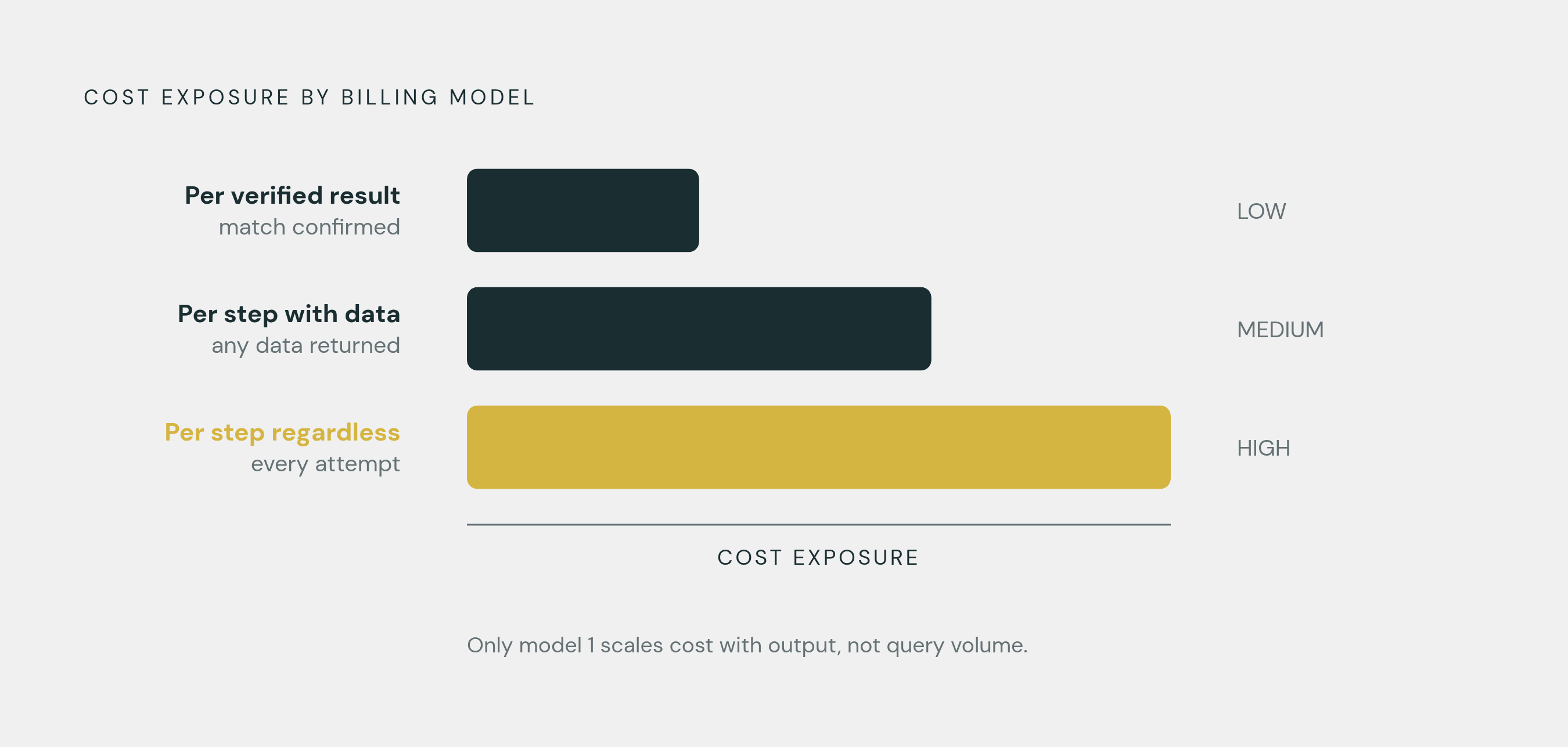
Three pricing models are in common use, and each one creates a different incentive, for better or worse. Under a per-verified-result model, a credit is charged only when a provider returns a valid, confirmed match, so a record that resolves to nothing costs nothing. This model lines up cost directly with output, which makes waterfall economics predictable: spend scales with how many contacts actually get resolved, not with how many queries the cascade had to run to get there. A per-step model works differently and charges for every provider call that returns any data, correct or not, whether that data turns out to be a confidently wrong guess or a clean match. A wrong answer returned early in the sequence, before the right provider in line finally resolves the record, still costs money under this model, and because a waterfall's whole structure depends on cascading through multiple providers per record, this pricing approach gets expensive fast on any list with a meaningful miss rate. A third model charges per step regardless of whether it returns data at all, billing for the attempt itself rather than for the result, which pushes that cost further still. Matching the pricing model to the actual miss rate of a given list, not just comparing sticker price per credit across vendors, is what keeps a waterfall's total cost in line with the value it delivers.