CRM Data Hygiene for Mid-Market Revenue Teams
Clean CRM data requires intake governance first, not better rep training.
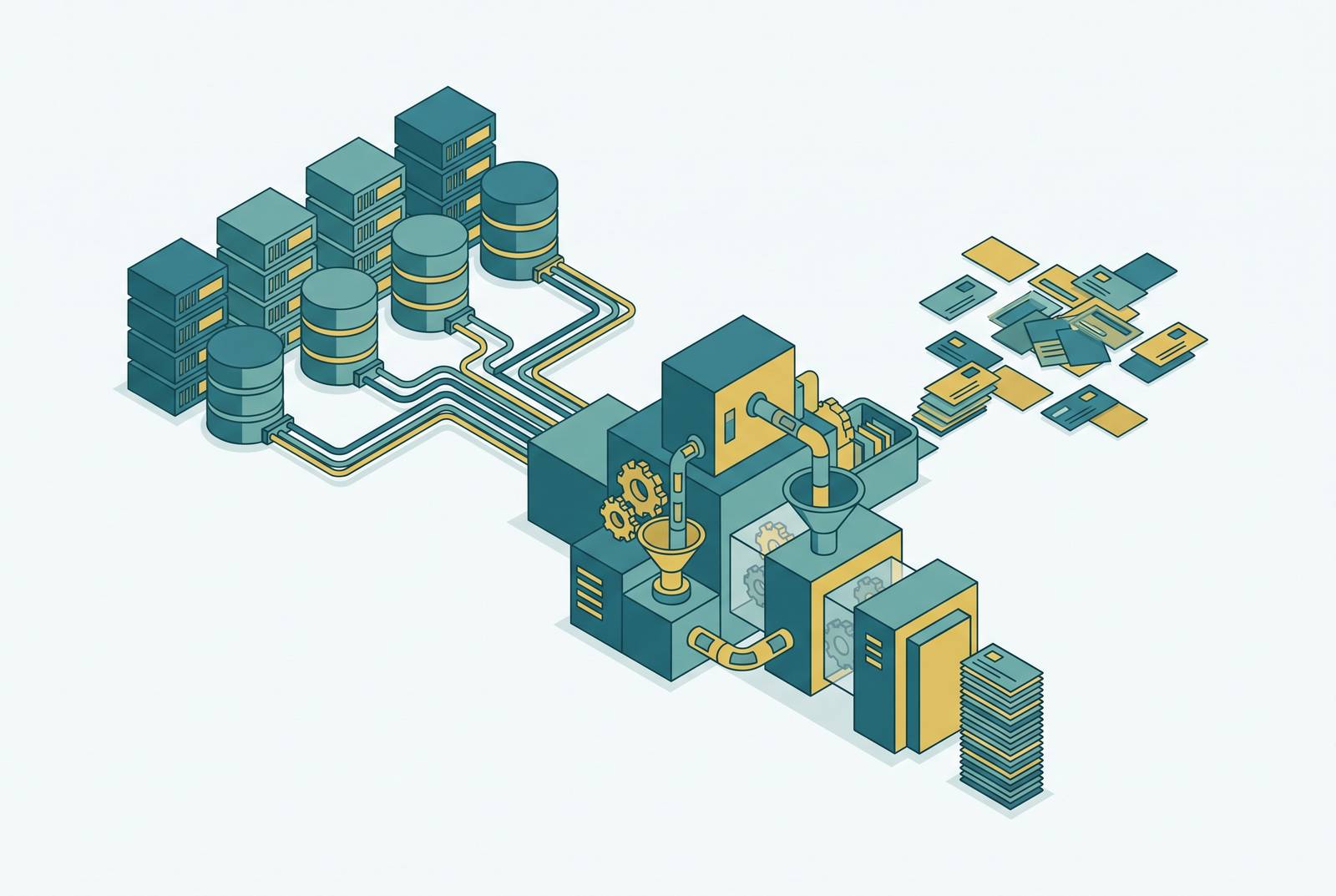
Mid-market CRMs break down faster than small-business or enterprise systems because the teams running them carry enterprise-level stack complexity, but they don't have the governance infrastructure to manage it. A gap in process design requires a process fix, not rep training. This piece lays out where dirty data enters a mid-market CRM, what it costs once it's there, and the sequence of fixes that actually holds.
Why mid-market CRMs degrade faster
A small-business CRM runs on a handful of integrations and simple routing logic, so when a record goes bad, the error stays isolated and easy to spot. If you don't explicitly define field mappings, sync priorities, and update logic, every one of those integrations can turn into a point of data corruption.
The decay compounds on two fronts at once. Neither force needs the other to do damage, and together they move faster than most mid-market teams expect.
The accountability gap makes mid-market teams especially exposed: no one owns data quality end to end, so errors compound unnoticed. By the time leadership notices, the damage has already been compounding for months.
The four entry points where dirty data enters a mid-market CRM
Dirty data doesn't arrive at random. It enters through four repeatable gaps, and until each one is closed at the source, any cleanup downstream only lasts until the next cycle of imports and form fills.
The first is form fills submitted without deduplication rules in place. If there's no match rule keyed to email domain or company ID, this happens on every inbound form submission from an account already in the system.
The second is list imports run without match logic. The overwrite runs in one direction by default: the import wins unless the CRM has been explicitly configured to favor the existing verified value instead.
The third is sales-created records that bypass validation. Reporting built on top of that fragmentation can't be trusted.
The fourth is enrichment tools configured to create records instead of updating them. The same tool, configured to update unconditionally instead, will just as easily overwrite a rep-verified job title with a scraped value that's months out of date.
The cost of these entry points: routing failures, forecast drift, and AI misfires
Each entry point has its own failure mode downstream, and those add up. A duplicated contact misroutes a lead, that lead lands in the pipeline under the wrong owner, and the forecast inherits the error once that bad pipeline gets rolled up into a total.
Forecast drift follows a similar path. Pipeline reviews start turning into arguments about whether the data can even be trusted, rather than discussions of deal strategy, and that argument is a direct tax on the time of RevOps and sales leadership alike.
AI tools raise the stakes further. Attention's analysis frames the underlying issue precisely: AI CRM hygiene is a field-level problem, not a notes problem. A call summary pasted into an activity record can't be filtered, forecasted, or routed on. Only structured field data drives downstream automation, and forecasting software reads whatever data it's given: an AI model trained on messy CRM records learns the bad habits already embedded in them.
CRM staleness also costs rep time directly. Salesforce's 2026 State of Sales report, drawn from a survey of more than 4,000 sales professionals, confirms that reps already spend the majority of their workweek on non-selling tasks, and CRM staleness adds to that overhead at every stage of the deal cycle.
The limits of training reps and enforcing entry standards
Treating bad CRM data as a rep behavior problem is a reasonable first instinct, but it misdiagnoses the cause, and it guarantees that whatever cleanup gets done will need repeating.
The enforcement loop fails on its own terms. If you apply those same rules uniformly across every field a CRM can hold, they degrade data quality while looking like they improve it.
Deduplication merges run on their own face a similar trap. The correct order, recommended by KDG (Kyle David Group), is to fix intake rules first, run deduplication merges second, and establish enrichment governance third. Reversing that order means the merge work gets undone by the next list import or form fill.
There's a real organizational tension here, too. More AI is entering the stack while fewer people are managing the data quality that AI depends on to function.
Apollo's analysis states the alternative directly: RevOps teams that treat hygiene as an ongoing operating system, rather than a quarterly cleanup project, see measurable gains in forecast reliability and rep efficiency. The fix is a process that doesn't depend on reps catching every error by hand.
Building the intake layer: validation rules, field governance, and integration controls that stop dirty data before it lands
You get the most durable hygiene payoff before anyone writes a record. Validation at the point of entry removes the compounding cost of cleaning bad data after the fact, and it's the first fix to build because every other process depends on it working.
Start with form fills. Progressive profiling, collecting additional fields across multiple interactions instead of demanding everything at once, lowers the temptation to fill a form with incomplete or placeholder answers just to get through it.
At the record level, required fields should be scoped to what routing, scoring, and forecasting actually use, not every field the CRM happens to offer.
Integration and enrichment governance need the same explicit rules. Field-level write rules should also separate rep-verified values, which enrichment shouldn't touch, from system-populated defaults, which enrichment can safely improve.
List imports need a matching step before anything gets written: a defined rule based on email, company domain, or a composite key, with the default behavior for a matched record set to merge. Running enrichment against unstandardized data wastes API calls and produces inconsistent matches that undercut everything downstream.
Running deduplication correctly: match logic, merge rules, and the sequencing that makes it stick
Deduplication only holds if it follows intake governance, uses fuzzy matching instead of exact matching, and merges records by protecting the most reliable field values, not just keeping whichever one arrived most recently.
Exact-match deduplication misses most of what it's supposed to catch. Fuzzy matching compares name, email, company, and phone together and assigns a confidence score: records above a set threshold get auto-merged, records in a middle band get flagged for a human to review, and records below the threshold stay separate.
Merge rules matter as much as the matching logic. The surviving record should inherit the most complete and most recently verified value for each field, not automatically the value from whichever record happens to win by creation date or by source. Rep-entered values for relationship fields, next steps, current stakeholder, deal context, should take precedence over system-generated or enrichment-supplied values describing the same thing.
Getting the sequence right is what makes all of this stick. A team importing lists monthly needs a monthly dedup run at minimum to keep pace.
Enrichment governance: what to enrich, which fields to protect, and preventing enrichment from becoming its own source of drift
Enrichment is the entry point most likely to get misconfigured, precisely because it feels like a pure improvement. Left unrestricted, enrichment can overwrite verified fields or populate fields no downstream process even uses, and that creates its own category of dirty data.
Field protection rules keep the tension in check. Fields where rep-verified data beats enrichment data, the current buying stakeholder, relationship context, deal-specific notes, should be marked enrichment-protected and left alone. Fields where enrichment tends to outperform rep entry, company headquarters, employee count, industry classification, are the right targets for automation.
Conflicts between enrichment sources need an explicit rule, too. Different providers tend to have different strengths by data type: contact-level data like email and direct dial is often served better by one source, account-level data like headcount and funding stage by another.
Freshness schedules should match decay rates, not run on a single blanket cadence. Apollo's analysis says continuously refreshed data is a prerequisite for any sales analytics program worth trusting.
Assigning ownership: the governance structure that keeps the process running without a full-time data team
A hygiene process only keeps running if a specific person or role is accountable for each piece of it. Spreading ownership vaguely across teams produces, in practice, no ownership.
The gap appears in a familiar pattern: without a named owner, sales assumes marketing will clean records before handoff, marketing assumes RevOps will standardize field formats, and neither one actually happens. The same source documents what follows: outdated records pile up, duplicates sit unmerged, and no team steps in to fix any of it, so hygiene stays invisible right up until it causes a failure everyone notices.
Mid-market teams without a dedicated data steward can still build a working ownership model with the roles they already have. A named RevOps lead carries the calendar itself, monthly dedup runs, quarterly audits, annual field schema reviews, and the process stalls without someone holding that calendar accountable.
The audit cadence is what keeps the whole structure from drifting. A quarterly full-database audit against defined completeness standards shows which of the four entry points is generating the most errors, so the team can prioritize fixes instead of treating every hygiene problem as equally urgent.
Tools that support a repeatable hygiene process at mid-market scale
The right toolset addresses each of the four entry points with purpose-built functionality, but you need to design the process first, and pick the tools after. If a team hasn't defined its field governance yet, it isn't ready to shop for enrichment tools.
Most native CRM platforms offer basic deduplication and required-field rules, but fall short on fuzzy matching, field-level merge logic, bulk standardization workflows, and enrichment governance controls, exactly the capabilities mid-market complexity demands.
Insycle is a CRM data management tool built for HubSpot, Salesforce, and other CRMs, handling deduplication, bulk operations, data formatting, and automated cleaning workflows. Openprise is a data and AI orchestration platform covering deduplication, standardization, enrichment governance, and lead routing, with pricing starting at the enterprise entry level, $35,000 or more per year, placing it toward the upper end of mid-market and above.
Clari is a revenue operations platform that pulls data from Salesforce, automatically captures rep activity, and rolls pipeline into a single forecast view with confidence levels. It fits mid-market to enterprise B2B teams that need a defensible pipeline number, and its value depends on whether the underlying CRM data is clean enough to forecast on. Apollo provides contact and account data enrichment with continuously refreshed records, and its own 2026 analysis documents what stale CRM data costs in productivity while it positions enrichment as a prerequisite for reliable sales analytics, a credible position because the analysis is so clear about what it actually measures.
Attention captures sales conversations and writes structured field-level data directly into CRM fields without rep retyping. Its August 2026 analysis draws a useful distinction between note summaries, which can't be filtered or routed on, and field-level write-back, which can, and that distinction matters for hygiene because only structured field data feeds downstream automation reliably.
For teams without the bandwidth to run DIY tooling, managed cleanup services are available. These address existing dirty records but don't fix the intake processes generating new ones, making them most valuable as a one-time reset ahead of a process redesign.
Making the hygiene process AI-ready: what clean data enables that dirty data prevents
A repeatable hygiene process is the foundation that decides whether the AI tools already entering the revenue stack produce reliable output or just scale the errors already in the CRM.
Attention's analysis makes the requirement precise: AI hygiene means structured, field-level data in the CRM, not prose summaries sitting in activity notes. A forecast model, a prioritization agent, or a routing algorithm can only act on what lives in a structured field, never on what's buried inside a block of text. Most AI forecasting platforms also need a period of clean pipeline data before they can generate reliable predictions, so teams running inconsistent CRM hygiene will see limited model accuracy no matter which platform they choose.
AI amplifies this problem sharpest of all. If an AI agent acts on a duplicate record, a stale job title, or a misrouted opportunity, it doesn't fail once and stop. It repeats that failure at machine speed across every action it takes involving that record, and the AI-readiness gap this creates is already a live organizational reality for teams rushing to adopt these tools without fixing what feeds them. Purpose-built AI hygiene agents are starting to enter RevOps stacks, and they detect missing, inconsistent, or outdated CRM data and recommend or perform corrections automatically. These tools extend the hygiene process rather than replace its governance layer, and they work best once the governance framework, field definitions, merge rules, enrichment scope, is already in place; they automate enforcement of a standard, not the creation of one.
A mid-market revenue team that builds out intake controls, deduplication sequencing, enrichment governance, clear ownership, and a working audit cadence is building the data infrastructure that every AI tool, forecasting model, and routing workflow in the stack depends on to function correctly. If teams defer this work while they adopt AI anyway, they don't move faster for having skipped it. At scale, they amplify the exact structural problem the hygiene process was built to solve.