Sender Reputation Recovery After a Deliverability Drop

Sender reputation recovery after a deliverability drop requires a sequence: confirm the damage, contain harmful sending, resolve the underlying causes, rebuild trust with engaged recipients, and increase volume only when signals are stable. Each phase creates the conditions for the next. Rushing ahead usually gives mailbox providers more evidence to distrust the sender.
Why a deliverability drop is harder to reverse in 2026 than it was two years ago
Mailbox providers have replaced forgiving filtering with harder enforcement while extending the behavioral history used to judge senders. Since November 2025, Gmail permanently rejects non-compliant bulk mail with hard 5xx SMTP errors. Microsoft introduced equivalent requirements for Outlook, Hotmail, and Live in May 2025, beginning with Junk placement and escalating to permanent 550 5.7.515 rejections. Authentication failures now meet a hard barrier. A sender cannot rebuild engagement with mail that the receiving provider will not accept.
But passing those checks does not undo the damage from past behavior. ISPs put more and more weight on complaint rates as their most important signal, while domain and IP reputation count for less than they used to. Automated anti-spam systems such as Orange apply restrictions when complaint thresholds are exceeded and observe behavior over an extended window before gradually lifting them. Damage can therefore accumulate faster than recovery proceeds. Restoring trust takes weeks of disciplined sending.
How a reputation death spiral works and why rushing the fix accelerates it
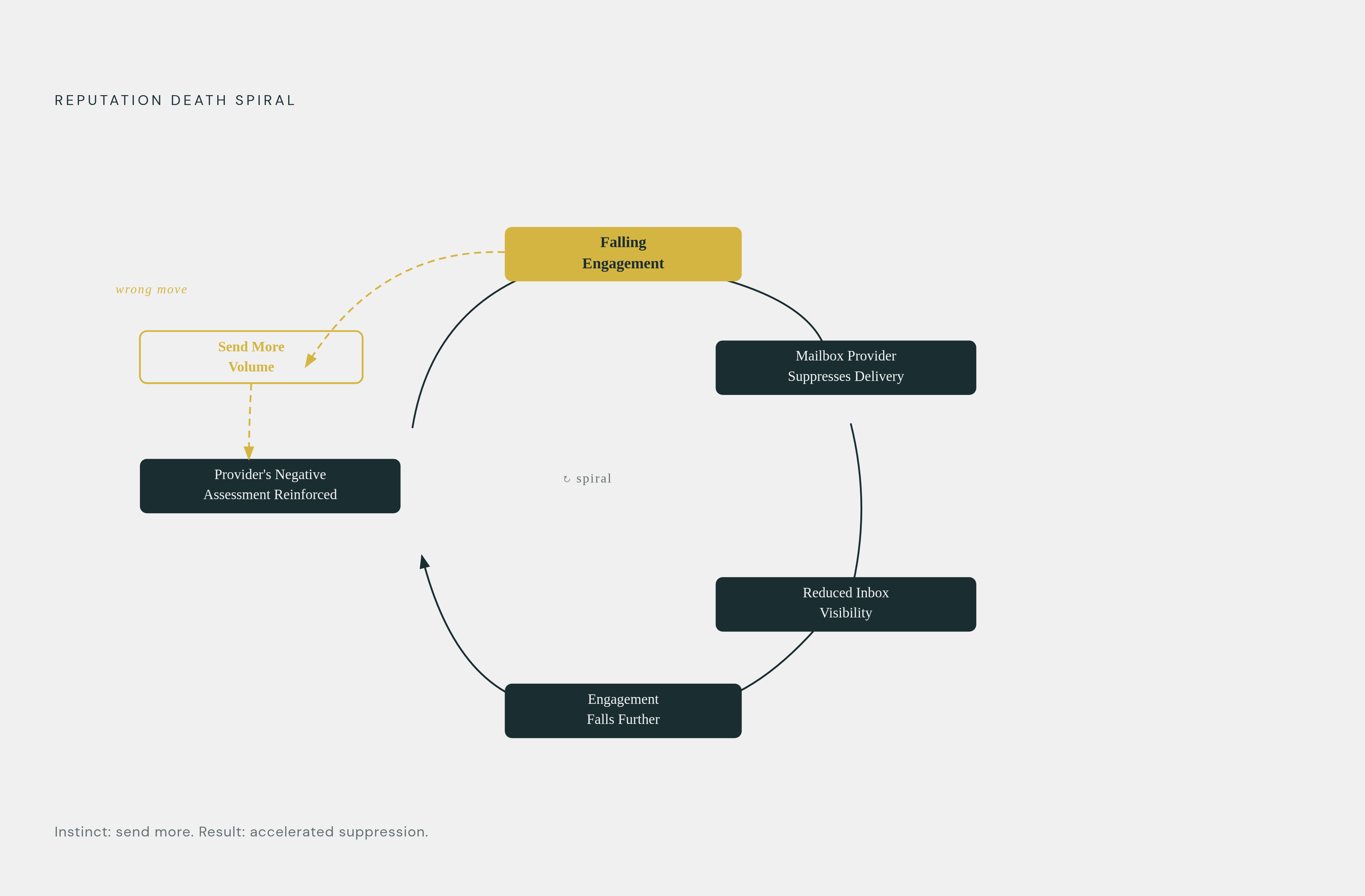
A reputation death spiral begins when falling engagement prompts mailbox providers to suppress delivery. Suppression reduces visibility, which lowers engagement further and reinforces the provider’s negative assessment. Low opens, clicks, and replies become part of that feedback loop. The sender then faces a dangerous temptation. Sending more to compensate for lost engagement increases exposure without correcting the behavior that caused delivery to decline.
The same error appears in infrastructure decisions. Warming a clean domain on a damaged IP leaves the IP problem in place, and asking for blocklist removal without changing the behavior that caused it can lead to another listing, sometimes within hours. Repeated listings are harder to clear. A blocklist entry is a sign that the sender needs to look into the cause beyond the listing itself and the steps needed to clear it.
This feedback loop determines the recovery sequence. Mailbox providers keep updating their behavioral models, so containment must stop new negative signals before rebuilding can create positive ones. Sending only to recipients most likely to interact positively gives that rebuilding phase a sound basis. Expansion must wait until complaints and bounces are clean, because an early ramp feeds the same spiral the sender is trying to escape.
Confirming the drop is real and scoping its severity before touching anything
Check whether inbox placement has fallen, since a change in engagement alone does not prove a delivery problem. ESP reporting can obscure the distinction because “delivered” means only that the receiving server accepted the message. Run third-party or internal seed tests across Gmail, Microsoft, Yahoo, and Apple. These tests expose placement differences that an aggregate dashboard can miss.
Compare open, bounce, and complaint rates by provider, then check major DNSBLs for both sending IPs and domains. A drop at just one provider points toward ISP-specific filtering and away from a problem with the domain as a whole. A blocklist entry may explain a more complete interruption, since some listings prevent delivery entirely until cleared. Scope comes before choosing the repair. Provider-level reporting and placement tests establish where the damage is visible, while domain and IP signals help identify the affected asset.
Read Google Postmaster Tools and Microsoft SNDS together. When domain reputation falls but the SNDS IP signal is clean, the problem is likely with the domain, content, or list. When the SNDS IP signal is red and Postmaster results are mixed, IP reputation is the most likely cause. A blocklist hit identifies an asset that needs clearance and stabilization before expansion. These findings determine where the sender enters the playbook and which domains, IPs, or provider relationships need attention first.
Stopping further damage: the first 48 hours of containment
Once the scope is clear, stop the sends that produce negative signals and keep clean sending streams running. For multi-brand operations, first document which brands, domains, and IPs sent during the decline window, since shared infrastructure can spread one brand’s acquisition damage to another. Pause promotional and acquisition campaigns aimed at unengaged or recently imported segments. Preserve transactional mail on clean domains and IPs. Receipts and password resets can maintain the engagement baseline without continuing the harmful marketing activity.
Next, suppress hard-bounced addresses, contacts past the sender’s defined sunset window, and every segment that came from purchased or scraped lists. Honor all unsubscribe requests that are still pending before the next send. Failure to honor one-click unsubscribes directly drives complaints, so a campaign should not proceed while those requests remain unresolved. Separate transactional, promotional, and low-trust acquisition streams by reputation tier where shared assets expose otherwise healthy mail.
Containment also calls for an infrastructure audit if the ESP has no ISP-level reporting, dedicated IP assignment, clear view of retry behavior, or way to enforce global do-not-send rules. List cleanup cannot make up for a sending setup that cannot support recovery. During this window, do not launch a re-engagement campaign or attempt a volume ramp while complaint rates remain elevated. Blocklist removal alone does not make it safe to return to normal sending. Once harmful sends have stopped and risky segments are suppressed, the sender has a stable window to address existing damage without adding more.
Diagnosing the root cause across four parallel buckets
Use that window to examine four diagnostic buckets in parallel, namely IP and domain reputation, list hygiene, content and frequency, and platform sending behavior. Enterprise drops often involve compounding causes. The dominant driver may sit in any bucket. Checking them sequentially risks treating the most visible symptom while a secondary cause continues to undermine recovery.
For IP and domain reputation, inspect blocklist status, Postmaster and SNDS trends, and the behavior of neighbors on shared IPs. High-complaint senders in a shared pool can damage Microsoft reputation even when authentication is correct. Internal brand portfolios create the same coupling when brands share pools. Dedicated IPs may therefore be necessary for high-value mail, with a structured warm-up. In parallel, examine list hygiene for dead addresses, spam traps, purchased or aged lists, sudden growth, and weak sunset discipline.
Content and frequency require a different distinction. Review spam-trigger language patterns, image-heavy templates, URL shorteners, urgency phrasing, and sending frequency against subscriber expectations. A sharp unsubscribe spike tied to one campaign suggests expectation mismatch, while a steady rise suggests over-mailing. Platform behavior can complicate the interpretation of other symptoms. Retry logic on deferrals, automatic handling of dead addresses, and send caps across brands affect bounce reports and must be understood before assigning cause.
Authentication remains a separate prerequisite across all four buckets. SPF must authorize every approved sending source, and DKIM must sign every outgoing message, including its From header, with RSA 2048-bit keys or longer that are rotated regularly. Begin DMARC with p=none and a rua reporting address, confirm that legitimate sources pass, then progress to p=quarantine and p=reject. Also verify valid forward and reverse DNS, including PTR records for sending IPs. Whatever the dominant cause, broken SPF or DKIM prevents a sender from passing Gmail’s and Microsoft’s compliance checks before engagement can support rehabilitation.
Rebuilding trust by sending only to the most engaged segment first
With the underlying causes addressed and authentication confirmed, begin sending only to the most engaged recipients. The purpose is to produce a clean behavioral record from subscribers most likely to interact positively. Segment composition takes precedence over raw volume. Exclude unengaged contacts, keep unsubscribes honored, and maintain consistent sending so that the rebuild does not reproduce the conditions that caused the decline.
Keep frequency conservative throughout this phase. Erratic spikes after a period of silence are themselves damaging behavior, even when the sender is eager to demonstrate renewed activity. Each controlled send contributes behavioral evidence that providers can assess, while continued suppression prevents weaker segments from diluting that evidence.
Warmup tools do not change that requirement. A gradual, monitored ramp supported by real engagement remains broadly accepted for a recovering domain, but tools cannot repair stale lists, authentication errors, or over-sending. Running warmup against broken SPF accomplishes nothing useful. The distinction is between supporting a sound recovery process and attempting to substitute a tool for one.
Run daily inbox placement seeds to affected ISPs until stabilization metrics hold. Track Postmaster compliance status, SNDS IP health, and seed results in one view so leadership can see them together without having to work through dashboards that disagree. These signals also establish the handoff to expansion. Readiness depends on stable placement and clean complaint, bounce, and deferral behavior.
Ramping volume safely once stabilization signals are clean
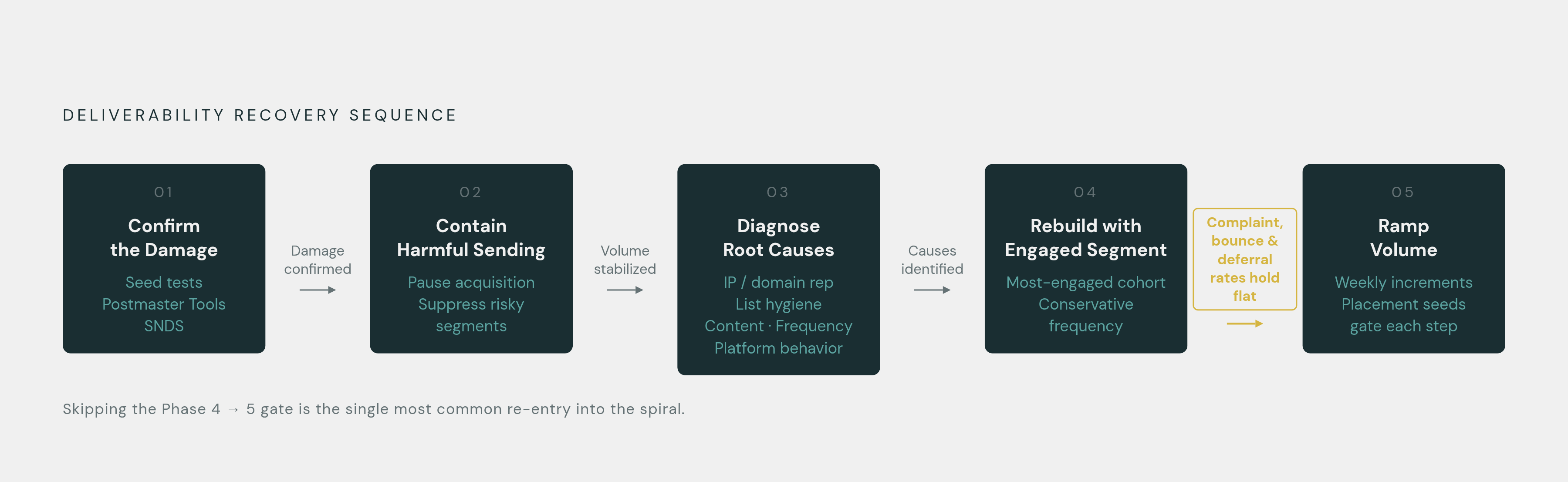
Increase daily send volume through steady weekly increments only while complaint rates, hard-bounce rates, and deferral rates hold flat. A week passing does not authorize an increase. Run inbox placement seeds before every weekly step and stop expansion if placement regresses. Expand the audience in engagement rings, starting with the strongest cohort and adding the next tier only after the first remains stable at its new volume.
Gmail compliance status in Postmaster Tools v2 must stay Pass, and any Fail status pauses the increase. For Outlook domains, reduce sending frequency while reputation recovers and submit a mitigation request through Microsoft’s Sender Support portal if blocking persists. Microsoft requires separate IP reputation diagnostics. Healthy domain-level signals alone do not establish that its ecosystem is ready for more mail.
Use the ramp to address shared-IP exposure where cross-brand contamination contributed to the decline. Moving high-value mail to dedicated IPs provides control, but it also makes the sender responsible for warm-up schedules, consistent volume, and monitoring. Transactional mail can stay on established domains while promotional mail follows its own plan. Separation gives each stream a sending structure that can be governed on its own terms.
For severe domain collapse with rehabilitation extending beyond many weeks, a fresh subdomain with structured warm-up may offer a faster path. That choice should reflect the timeline and business cost. A new subdomain does not remove the need to correct the underlying behavior. Recovery is complete only when the monitoring cadence and governance can catch the next deviation before it compounds, rather than merely when volume returns to its pre-drop level.
Preventing the next drop: the operational practices that make recovery unnecessary
Maintain complete SPF, DKIM, and DMARC configuration, with p=reject reached after legitimate sources have been validated. DNS changes, new sending domains, and new ESP configurations can silently break alignment, so authentication cannot be treated as a completed setup task. Keep DKIM rotation and DMARC rua reporting active.
Treat complaint rate as a standing operational KPI. Gmail’s complaint threshold constrains recovery options when crossed, making routine tracking essential. Centralize approval of new list sources as well. Regional teams importing unvetted contacts or creating shadow domains can reintroduce the same risks that containment removed, especially when brands share infrastructure. Acquisition governance protects the reputation of mail beyond the campaign that introduced the contacts.
Maintain weekly inbox placement seeds at steady state and daily tests during peak sending seasons, with Postmaster and SNDS reviewed in one consolidated dashboard. This cadence turns deliverability from a reactive technical function into revenue protection. Mail that does not reach the inbox cannot generate revenue, regardless of its creative quality. The recovery playbook should serve as a one-time repair, while its disciplines become routine maintenance. The goal for every sender that completes it is to never need it again.