Spam Filter Triggers That Kill Cold Email Deliverability
Diagnose authentication first, then behavior, content, and engagement to restore inbox placement.
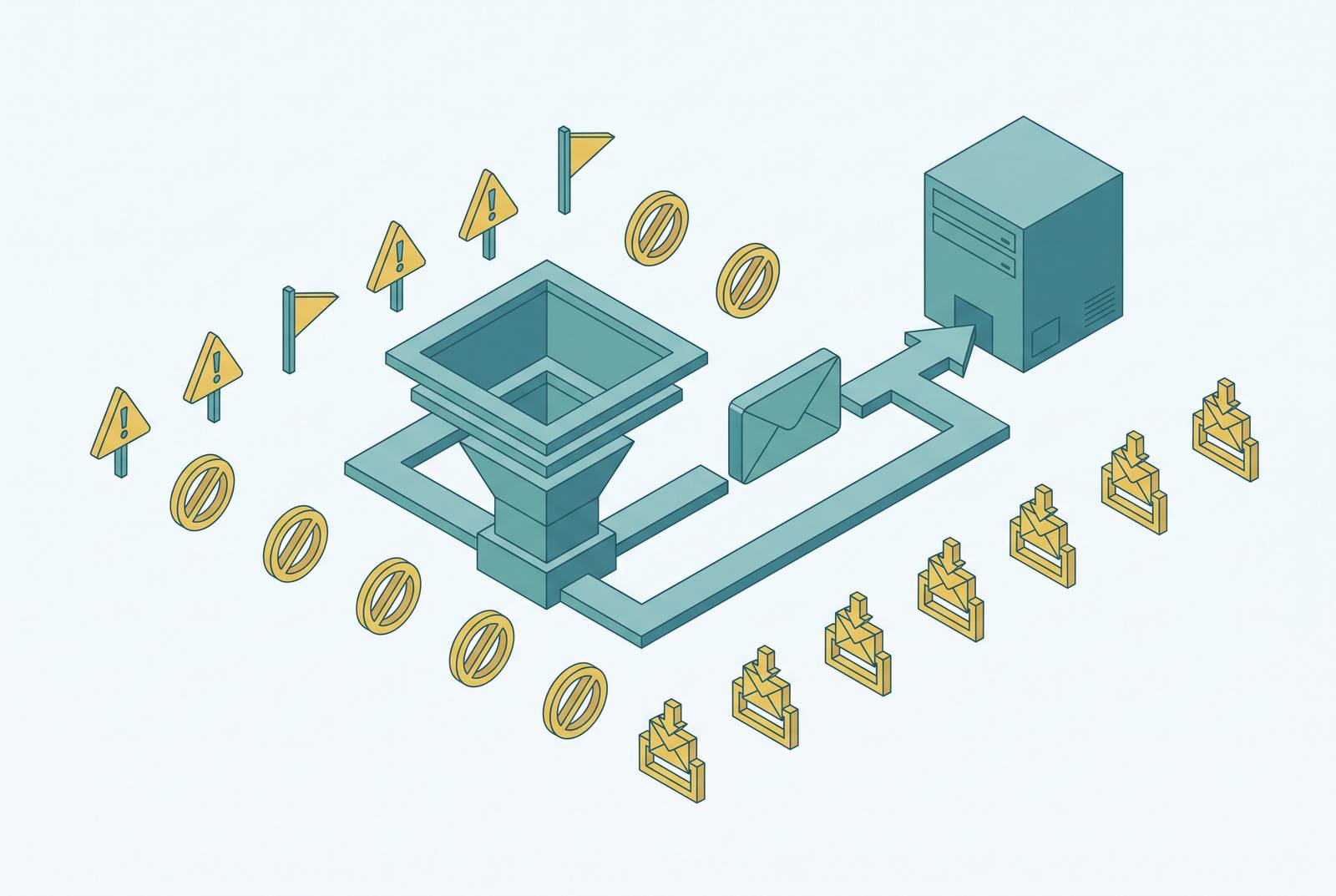
Cold email spam triggers in 2026 operate across four layers, which are authentication, sending behavior, content patterns, and engagement signals. Their weight is unequal. Authentication controls a message’s entry into the system, while behavior and engagement shape its chances of reaching the inbox over time. Deliverability improves when senders diagnose those layers in order.
Why cold email deliverability got structurally harder between 2024 and 2026
Google and Yahoo mandated SPF, DKIM, and DMARC for bulk senders starting February 2024. Outlook.com, Hotmail, and Live.com began rejecting non-compliant bulk mail with error 550 5.7.515 on May 5, 2025. Gmail escalated to full enforcement in November 2025, with non-compliant mail subject to temporary 4xx deferrals and permanent 5.7.x rejections at scale. The providers made discrete changes to the enforcement of bulk-sender requirements. A single misconfigured domain could now fail across the providers covering most of a typical B2B list.
Google Postmaster Tools v2 also took the place of the old four-tier reputation dashboard starting September 30, 2025. Its Compliance Status dashboard now shows Compliant, Needs Work, or No Data Found in place of Bad/Low/Medium/High. That change removed the intermediate reputation grades operators had used to spot deterioration. Although the dashboard has three states, it no longer supplies the same graduated warning before intervention becomes necessary.
The four-layer taxonomy spam filters actually use and why the order of layers matters
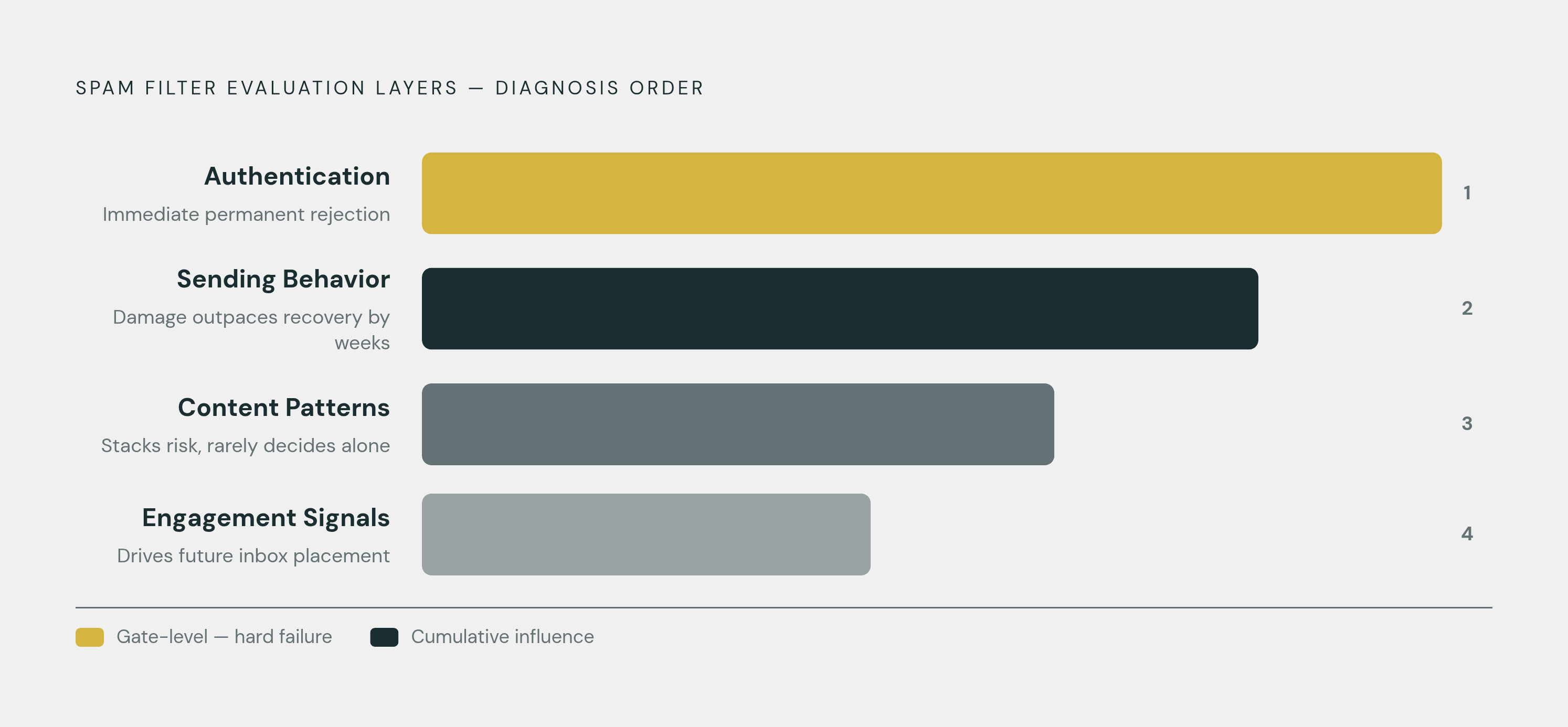
The first layer, authentication, acts as the gate. A failure can produce a hard rejection before content quality matters. That makes authentication the first diagnostic priority, regardless of how carefully the message was written.
The second layer is sending behavior, including volume, cadence, bounce rate, and complaint rate. These signals accumulate over time. A domain can clear authentication while steadily damaging the reputation that determines future placement.
The third layer is content, including formatting, link structure, and phrase patterns. Filters weigh these signals together, so a sales word on its own does not make an email forbidden.
The fourth layer is engagement, which feeds recipient responses back into reputation. Its position in the diagnostic sequence does not make it the least important influence on an established program. Engagement can become the dominant force in long-term placement, while content remains a smaller component. The hierarchy separates what must work first from what must keep working.
Authentication failures: the only layer that produces an immediate, permanent rejection
Authentication carries the greatest immediate weight because failure can produce a permanent rejection regardless of sending history or content. SPF authorizes the servers allowed to send from a domain. Its common failure is exceeding the DNS lookup limit by stacking too many include mechanisms. A record can therefore exist without providing a working authorization path.
DKIM cryptographically signs each email. Proper configuration in 2026 uses 2048-bit keys, with rotation at least annually. Keys need upkeep because a compromised key lets someone else send authenticated mail on the domain’s behalf. A valid signature is not enough if control of the signing key has been lost.
DMARC ties SPF and DKIM together and tells receivers how to handle failures. Its three policy levels are p=none for delivery and reporting, p=quarantine for spam placement, and p=reject for blocking. The p=none policy is the minimum floor. Stricter policies signal legitimate operation and are associated with better inbox placement, but alignment must be confirmed before moving to rejection.
Bulk compliance also requires RFC 8058 one-click unsubscribe for senders reaching Gmail or Yahoo at volume. A List-Unsubscribe header with an HTTPS endpoint must be present, and requests must be honored promptly. These controls belong on dedicated sending domains separate from the primary business domain. Recognizable close variations, each supporting two to three mailboxes at controlled volume, protect internal communications, transactional mail, and customer correspondence from outreach reputation damage.
Sending behavior: the layer that accumulates or destroys domain reputation over time
Passing authentication does not give a sender a lasting right to inbox placement. CloudScale Solutions’ delivery rate fell from near-perfect to well below acceptable within weeks after aggressive volume on a single domain. A startup’s primary domain was blacklisted after a single week of aggressive outreach. Both cases expose the same constraint, namely that volume can destroy reputation faster than a new program earns it.
Complaint rate is the most sensitive behavioral signal. Its denominator is inbox-delivered mail, so bounces and spam-folder placements do not dilute the rate. Once a domain crosses Gmail’s hard threshold, it needs seven consecutive days of clean sending to qualify again for delivery mitigation support. That is not a recovery guarantee. Actual inbox recovery can take weeks longer and may not happen.
Cadence and list quality create separate pressures. Batch sends at fixed times look like machine behavior, while sends spaced at natural-looking intervals across business hours do better. Invalid addresses generate hard bounces that degrade reputation independently of complaints. Spam traps in decayed lists can accelerate that damage and trigger blocklisting. Suppressing unsubscribes and previous complainants, and removing non-responders after a defined cadence, prevents repeated negative signals.
New or cold domains therefore need to build up slowly to a controlled daily volume. That process is distinct from using warm-up networks, whose simulated engagement is a recognized liability. After reputation damage, recovery takes time and clean sending. Behavioral reputation is an accumulated record.
Content patterns: what formatting and phrase choices still move the spam score in 2026
Once authentication is clean and behavior is controlled, the message itself becomes the next variable. Content scoring is composite and context-dependent. A mild sales phrase on its own is unlikely to decide where an otherwise clean B2B email lands. Stacking several signals on top of already marginal reputation poses a greater risk.
Urgency and pressure language carry the highest phrase risk because manufactured time pressure is common in spam and phishing. Examples include “act now,” “limited time,” and “urgent response needed.” One instance may be survivable, but three urgency phrases in a short email can resemble a phishing attempt. Financial and money language follows in weight because filters associate raw cash terms with fraud. Framing a B2B offer around value rather than cash reduces that risk without changing the offer.
Promotional language is more often a slow penalty than a hard trigger. Words such as “guaranteed,” “revolutionary,” and “exclusive” make outreach resemble a marketing newsletter, while “click here” remains a liability with legacy filters. Deceptive familiarity creates a different problem. Fake conversation subjects such as “Re: our chat” and impersonated internal threads such as “Re: invoice” attract stronger penalties once recipients flag them.
Formatting can add risk independently of wording. ALL CAPS subjects still hurt on their own, and heavy HTML with images, colored buttons, and branded headers is poorly suited to cold outreach. Plain text or minimal HTML is the recommended format. Three or more links and shortened URLs also raise concern, with shortened links hiding the destination behind an untrusted domain. Click-tracking redirects can create the same problem.
Measurement can obscure these effects. Apple Mail Privacy Protection pre-loads tracking pixels regardless of whether recipients open a message, inflating open rates and weakening their value as an optimization metric. When deliverability suffers, disabling open tracking and measuring replies instead is recommended. Avoiding risky patterns and writing genuinely personalized messages are complementary controls.
Engagement signals: the feedback loop that determines long-term inbox placement
Clean content cuts risk, but a sender earns trust over time through recipients’ actions. Gmail evaluates actions including replies, marks as important, moves out of spam, deletions without reading, and spam reports. Positive responses build reputation and help later messages reach the inbox. Negative responses make future filtering more likely.
Every ignored or reported message can make the next one harder to place, so reputation damage is not linear. ICP-tight targeting and personalization based on real recipient signals address this mechanism directly. They give recipients a reason to respond and reduce the likelihood of spam reports.
Warm-up networks cannot substitute for that relevance because simulated engagement is itself a recognized liability. Real responses must come from list quality, an offer that fits the recipient, and personalization. Their effect must also be measured at the right destination. A send log can report an email as delivered even when it reaches spam and generates no meaningful interaction. Inbox placement is therefore the KPI that reflects engagement-layer health.
How to diagnose which layer is causing a deliverability problem before trying to fix it
Because the layers affect each other, what looks like a content problem may start somewhere else. Diagnosis starts with SPF alignment, DKIM signature validity, and DMARC policy level. Alignment failure can cause rejection without being visible in send logs. Google Postmaster Tools v2 provides the primary Gmail compliance view, but its status model should not be mistaken for a gradual reputation forecast.
Once authentication passes, complaint rate, bounces, and volume become the next evidence. Movement toward 0.10% complaint rate calls for a review of targeting, relevance, and volume. Bounce analysis must separate hard bounces, including invalid addresses and permanent failures, from temporary soft bounces. A high hard bounce rate points to a problem with list hygiene. A high soft bounce rate on valid addresses points to a problem with reputation or authentication.
The distinction between a blocklist entry and reputation decay also matters. A blocklist listing is a discrete event with a documented removal process. Gmail reputation decay has no corresponding list or removal form. Apollo’s verified contact data addresses the list-quality problem that feeds both behavioral penalties and poor engagement. It is relevant when the evidence points to contact accuracy.
Only after those checks should diagnosis move to content patterns and then engagement. A content review checks for phrase categories stacked together and looks at formatting and links. An engagement check looks at whether recipients respond positively or keep ignoring and reporting messages. Following that order prevents the expensive mistake of applying a valid remedy to the wrong layer.
What a compliant cold email infrastructure looks like when all four layers are addressed together
Dedicated sending domains isolate outreach risk, while SPF, maintained DKIM keys, and DMARC establish authorization. The operational policy starts at p=quarantine, with p=reject as the target once alignment is confirmed. Verified PTR records on sending IPs and compliant one-click unsubscribe complete the infrastructure around that gate. These controls support clean sending but cannot manufacture a good reputation.
Behavioral controls then limit how much risk the system introduces. Fully warmed mailboxes operate under controlled daily ceilings, new domains ramp gradually, and sends are distributed across business hours. Hard bounces are removed immediately, and lists are verified before each new campaign sequence. When complaints near 0.10%, senders review targeting before enforcement becomes a problem.
Content and engagement complete the system. Plain text or minimal HTML, one or two links at most, and no shortened URLs keep message construction restrained. Click tracking is disabled or confined to trusted sending infrastructure. Honest subjects and copy that avoids stacking urgency or promotional claims help prevent penalties. Real contextual personalization then addresses template patterns that AI-powered filters can recognize even without trigger words.
Apollo provides verified contact data, domain health monitoring, and sequence tooling that fit the list-quality and engagement requirements of this system. Those capabilities are a practical starting point. Authentication establishes eligibility, behavior builds reputation, content avoids penalties, and engagement sustains placement. Reliable deliverability depends on all four layers working together.